TL;DR

Get home appliances delivered free with Prime
- Fast, free delivery on millions of items
- Prime Video, Amazon Music and more included
- Member-only deals all year
A Hunker report recommends corrugated aluminum as an alternative to wood for backyard sheds, citing resistance to rot, insects and rust, along with lower upkeep. The report gives broad price estimates for wood and metal sheds, but does not provide a direct, like-for-like comparison or independent testing of specific products.
The report says wood sheds can deteriorate after repeated exposure to rain, humidity and snow, and may also attract pests. It describes corrugated aluminum as resistant to those problems, as well as to salt spray and acid rain. Aluminum forms a stable oxide layer that protects its surface, rather than rusting like iron-based metals, according to the report.
Corrugation means pressing a metal sheet into repeating ridges and grooves. Hunker says those folds make aluminum panels stiffer than flat sheets and help channel rain away from screw holes, where leaks can develop. The report also cautions that aluminum itself is relatively soft; its suitability depends in part on the added stiffness provided by the panel shape and on the shed’s construction.
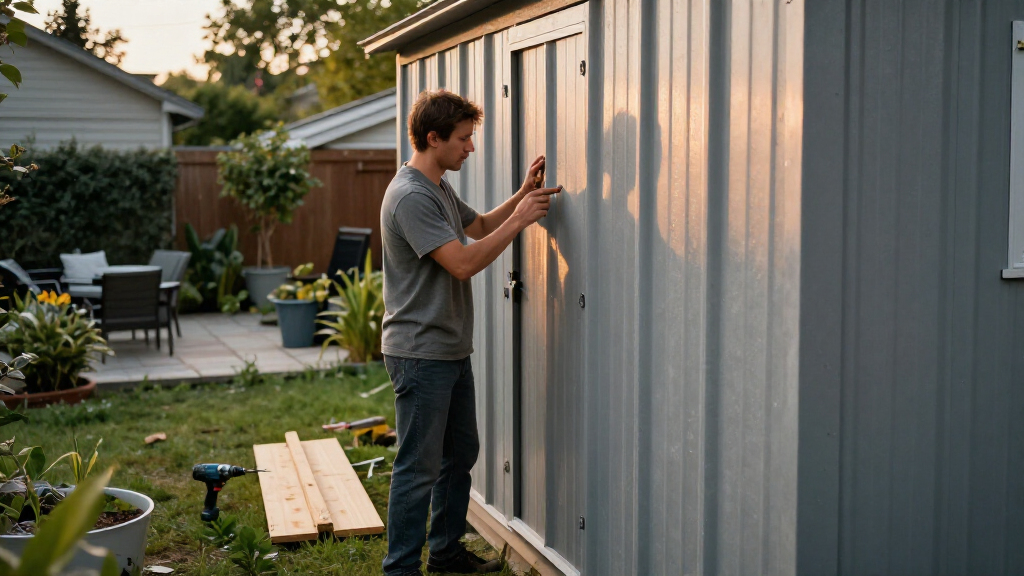
For upkeep, the article contrasts aluminum with wood that may need sealant every few years and paint or stain every five to 10 years. It says an aluminum shed generally needs occasional rinsing and inspection for scratches. It also notes that panels can have sharp edges and advises DIY installers to wear heavy-duty gloves and safety glasses.
Less Upkeep, Different Trade-Offs
The appeal is not just the shed’s initial price: homeowners may also spend time and money maintaining wood. A material that does not rot or attract termites could reduce some recurring repairs, particularly in humid or coastal settings. Hunker also says aluminum panels are light enough to handle more easily than lumber, potentially simplifying delivery and assembly for a DIY project.
Those benefits do not settle every purchasing decision. The report offers broad estimates rather than prices for identical sheds with the same size, foundation, features and installation. Buyers still need to check the product’s structural rating, warranty, local weather suitability and total installed cost. A lower-maintenance material may be attractive, but a shed’s performance depends on more than its cladding.
Products Worth Considering

Milwaukee M18 FUEL Automotive Combo Kit, 1/2-Inch High-Torque and 3/8-Inch Impact Wrenches

DEWALT 20V MAX Brushless 9-Tool Power Tool Combo Kit with Battery and Charger (DCK921P1)

EGO POWER+ 21-Inch Cordless Self-Propelled Lawn Mower Kit, LM2135SP
As an affiliate, we earn on qualifying purchases.
How Aluminum Panels Differ
Hunker cites Angi estimates of $3,000 to $15,000 for a wood shed and $500 to $7,000 for metal sheds. The figures are presented as general ranges; the report does not specify that they compare sheds of equivalent size or quality, nor does it break out the cost of corrugated aluminum separately. Readers should treat them as a starting point, not a project quote.
The article gives one example of panel weight: a 7/8-inch corrugated aluminum panel from Arconic is listed at 0.62 pounds per square foot. That product-specific figure illustrates why some panels may be easier to carry, but it does not establish the weight or strength of every shed kit. Corrugation can stiffen a sheet, while the complete structure’s resistance to wind and other loads also depends on framing, fasteners and anchoring.
““It doesn’t rot, won’t develop rust, and pests have little interest in it.””
— Hunker report
Product Costs and Performance Vary
The supplied report does not identify a specific shed kit, provide independent durability testing, or compare the expected service life of aluminum and wood structures. It also does not specify how the quoted price ranges vary by shed size, panel thickness, foundation, labor or included features. Its claims about resistance should not be read as a guarantee that a shed is immune to damage.
Wind performance is another open question for any particular installation. The report notes that aluminum is soft and says corrugation adds stiffness, but it does not give a wind rating or explain anchoring requirements. It also recommends inspecting panels for scratches without detailing how damage should be repaired or how a specific product’s finish should be maintained. Buyers should consult the manufacturer’s specifications and local requirements before choosing a kit.
Compare Kits Before Buying
Homeowners considering a shed can compare aluminum and wood kits by total installed price, dimensions, materials and warranty, rather than relying on broad material-level estimates. They should check wind-load and anchoring guidance, panel thickness, corrosion protections and any foundation or permit requirements that apply to their property.
For a DIY installation, follow the kit maker’s instructions and use heavy-duty gloves and safety glasses when handling metal panels. The report does not announce a new product or policy change; its practical next step for readers is to assess their own climate, maintenance tolerance and project budget against the specifications of available sheds.
Key Questions
Why does the report recommend corrugated aluminum for sheds?
It says the material resists rot, insects and rust, and that corrugated ridges stiffen the panels and direct rain away from screw holes.
Does corrugated aluminum need no maintenance?
No. The report says upkeep is generally limited to occasional rinsing and inspecting for scratches; it does not claim that aluminum sheds need no care.
Is an aluminum shed always cheaper than a wood shed?
The report cites broad Angi estimates of $500 to $7,000 for metal sheds and $3,000 to $15,000 for wood sheds. It does not compare equivalent models, so actual prices can differ.
Are corrugated aluminum panels strong enough for high winds?
The report says corrugation makes panels stiffer than flat aluminum, but it provides no wind rating. Check the manufacturer’s load and anchoring specifications for the specific shed and site.
What safety gear should DIY installers use?
Hunker advises wearing heavy-duty work gloves and safety glasses because panel edges are sharp. Follow the kit instructions and applicable local rules.
Source: hunker.com