
Indoor air quality monitors can track different things, so the right choice depends on whether you care most about carbon dioxide, particles, radon, or a broad set of readings. My best overall pick is the AirGradient ONE for its focus on several useful pollutants and Home Assistant compatibility. The Airthings View Plus stands out for buyers who want radon monitoring, while the Aranet4 is a more focused choice for tracking CO₂. The central tradeoff is broad sensor coverage versus a simpler device that concentrates on a specific concern, with display, app support, and power needs adding further differences. Read on for the full breakdown of all 15 options and guidance on matching a monitor to your home.

Get home appliances delivered free with Prime
- Fast, free delivery on millions of items
- Prime Video, Amazon Music and more included
- Member-only deals all year
Complete the kit


Key Takeaways
- AirGradient ONE is the most versatile specialist pick: its PM2.5, CO₂, TVOC, NOx, temperature, and humidity coverage suits buyers who want multiple readings and Home Assistant compatibility.
- Radon needs a dedicated sensor: the Airthings View Plus addresses a concern that broad-reading display models may not cover.
- The amazon.com/dp/B0GKHCXBG8?tag=timerone-20&ascsubtag=dc-1298367″ target=”_blank” rel=”nofollow sponsored noopener”>amazon.com/dp/B07YY7BH2W?tag=timerone-20&ascsubtag=dc-1298367″ target=”_blank” rel=”nofollow sponsored noopener”>Aranet4 prioritizes CO₂ over breadth: it makes more sense for ventilation awareness than for buyers seeking a wide range of pollutant readings.
- Many 16-in-1 listings emphasize display and sensor count: compare the stated measurements and usability rather than treating a larger number as proof of better monitoring.
- Amazon’s single and two-monitor options fit different layouts: the two-pack can help compare rooms, while one monitor is a simpler starting point for a single area.
| 16-in-1 Indoor Air Quality Monitor with HD Color Screen | 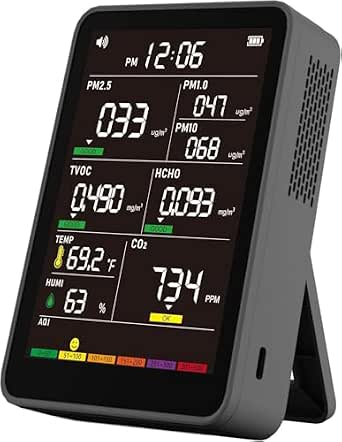 | Best for Fast, Multi-Metric Spot Checks | Measurements: PM1.0, PM2.5, PM10, CO2, TVOC, HCHO, temperature, and humidity | Sampling interval: 1.5 seconds | Battery life: 4–5 hours | VIEW LATEST PRICE | See Our Full Breakdown |
| 16-in-1 Indoor Air Quality Monitor with Color Display |  | Best for a Light-Colored Room Setup | Measurements: PM1.0, PM2.5, PM10, CO2, TVOC, HCHO, temperature, and humidity | Sampling interval: 1.5 seconds | Battery runtime: 4–5 hours | VIEW LATEST PRICE | See Our Full Breakdown |
| YNAK 16-in-1 Indoor Air Quality Monitor with 7-Inch Display |  | Best for Large, Easy-to-Read Displays | Display: 7-inch LED with three brightness settings | Monitored parameters: CO2, PM1.0, PM2.5, PM10, HCHO, TVOC, temperature, humidity, AQI, and time | Alerts: Seven AQI alert buzzer types with mute button | VIEW LATEST PRICE | See Our Full Breakdown |
| 16-in-1 Indoor Air Quality Monitor with Color Screen |  | Best for Adjustable Audio Prompts | Measurements: PM1.0, PM2.5, PM10, TVOC, HCHO, carbon dioxide, temperature, and humidity | Sampling interval: 1.5 seconds | Display: HD color screen with color-coded readings | VIEW LATEST PRICE | See Our Full Breakdown |
| Qingping Air Quality Monitor Gen 2 |  | Best for App-Based Monitoring and History | Measurements: Temperature, humidity, CO2, PM2.5, PM10, eTVOC, and noise | Display: 4-inch IPS touchscreen, 254 PPI | Connectivity: 2.4GHz and 5GHz Wi-Fi | VIEW LATEST PRICE | See Our Full Breakdown |
| Aranet4 Indoor Air Quality Monitor with Wireless CO₂ Detector |  | Best for CO₂-Focused Monitoring | Measurements: CO₂, temperature, relative humidity, atmospheric pressure | Sensor technology: NDIR | Display: E-ink | VIEW LATEST PRICE | See Our Full Breakdown |
| Heouakc 10-in-1 Indoor Air Quality Monitor |  | Best for App-Free, Broad Readings | Measurements: PM0.3, PM2.5, PM10, CO₂, CO, HCHO, TVOC, AQI, temperature, humidity | Sampling interval: 1.2 seconds | Battery capacity: 2000mAh | VIEW LATEST PRICE | See Our Full Breakdown |
| Qingping Air Quality Monitor Gen 2 |  | Best for Connected Home Monitoring | Metrics: Temperature, humidity, CO₂, PM2.5, PM10, eTVOC, noise | Display: 4-inch IPS touchscreen, 254 PPI, automatic brightness | Connectivity: 2.4 GHz or 5 GHz Wi-Fi; Qingping+ app | VIEW LATEST PRICE | See Our Full Breakdown |
| 16-in-1 Indoor Air Quality Monitor with 5.5-Inch HD Display | 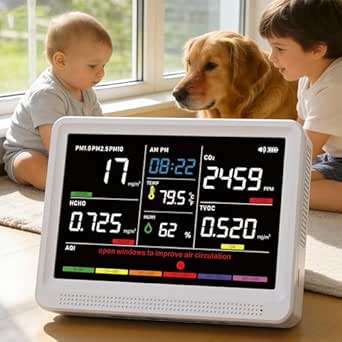 | Best for a Large Portable Readout | Measurements: CO₂, PM2.5, PM1.0, PM10, HCHO, TVOC, temperature, humidity, AQI | Display: 5.5-inch HD LED | Battery runtime: Up to 10 hours | VIEW LATEST PRICE | See Our Full Breakdown |
| Amazon Smart Air Quality Monitor (2-Pack) |  | Best for Alexa Automation | Monitored factors: PM2.5, VOCs, carbon monoxide, humidity, temperature | Connectivity: Alexa app and compatible Echo devices | Alerts: Phone notifications and Echo announcements | VIEW LATEST PRICE | See Our Full Breakdown |
| Amazon Smart Air Quality Monitor | | Best for Alexa Households | Sensors: Temperature, humidity, carbon monoxide, PM2.5, and VOCs | Connectivity: 2.4 GHz Wi-Fi and Bluetooth Low Energy 4.2 | Status indicator: Multicolor LED | VIEW LATEST PRICE | See Our Full Breakdown |
| BREATHE Airmonitor Plus Gen 2 Indoor Air Quality Monitor |  | Best for Detailed Tracking | Measurements: CO₂, PM1, PM2.5, PM10, TVOC, formaldehyde (HCHO), temperature, and humidity | CO₂ sensor: NDIR | Connectivity: 2.4 GHz Wi-Fi | VIEW LATEST PRICE | See Our Full Breakdown |
| AirGradient ONE Indoor Air Quality Monitor – PM2.5, CO2, TVOC, NOx, Temperature & Humidity, Home Assistant Compatible | 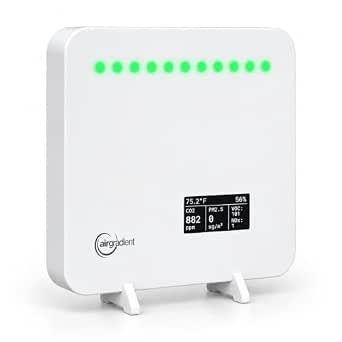 | Best for Open Smart-Home Integration | Sensors: SenseAir NDIR CO₂; Plantower PMS5003 laser particle; Sensirion SGP41 TVOC/NOx; Sensirion SHT40 temperature and humidity | Display: 1.3-inch OLED and 11-LED color bar | Enclosure: UV-resistant ASA | VIEW LATEST PRICE | See Our Full Breakdown |
| Lwyinp MT13S 10-in-1 Indoor Air Quality Monitor |  | Best for Portable At-a-Glance Readings | Measurements: CO₂, HCHO, TVOC, AQI, PM2.5, PM1.0, PM10, temperature, and humidity | Display: High-definition color screen with three-color air-quality visualization | Connectivity: Bluetooth for time calibration | VIEW LATEST PRICE | See Our Full Breakdown |
| Airthings View Plus Battery-Powered Radon and Air Quality Monitor |  | Best for Radon Monitoring | Sensors: Radon, PM2.5, CO₂, VOCs, humidity, temperature, and air pressure | Connectivity: Wi-Fi | Power: Battery-powered | VIEW LATEST PRICE | See Our Full Breakdown |
| indoor air quality monitor | Display | Measurements | Connectivity |
|---|---|---|---|
| 16-in-1 Indoor Air Quality Mon | HD color screen | PM1.0, PM2.5, PM10, CO2, TVOC, HCHO, temperature, and humidity | — |
| 16-in-1 Indoor Air Quality Mon | HD color screen | PM1.0, PM2.5, PM10, CO2, TVOC, HCHO, temperature, and humidity | — |
| YNAK 16-in-1 Indoor Air Qualit | 7-inch LED with three brightness settings | — | — |
| 16-in-1 Indoor Air Quality Mon | HD color screen with color-coded readings | PM1.0, PM2.5, PM10, TVOC, HCHO, carbon dioxide, temperature, and humidity | — |
| Qingping Air Quality Monitor G | 4-inch IPS touchscreen, 254 PPI | Temperature, humidity, CO2, PM2.5, PM10, eTVOC, and noise | 2.4GHz and 5GHz Wi-Fi |
| Aranet4 Indoor Air Quality Mon | E-ink | CO₂, temperature, relative humidity, atmospheric pressure | — |
| Heouakc 10-in-1 Indoor Air Qua | — | PM0.3, PM2.5, PM10, CO₂, CO, HCHO, TVOC, AQI, temperature, humidity | No Wi-Fi, Bluetooth, or app connectivity |
| Qingping Air Quality Monitor G | 4-inch IPS touchscreen, 254 PPI, automatic brightness | — | 2.4 GHz or 5 GHz Wi-Fi; Qingping+ app |
| 16-in-1 Indoor Air Quality Mon | 5.5-inch HD LED | CO₂, PM2.5, PM1.0, PM10, HCHO, TVOC, temperature, humidity, AQI | — |
| Amazon Smart Air Quality Monit | — | — | Alexa app and compatible Echo devices |
| Amazon Smart Air Quality Monit | — | — | 2.4 GHz Wi-Fi and Bluetooth Low Energy 4.2 |
| BREATHE Airmonitor Plus Gen 2 | — | CO₂, PM1, PM2.5, PM10, TVOC, formaldehyde (HCHO), temperature, and humidity | 2.4 GHz Wi-Fi |
| AirGradient ONE Indoor Air Qua | 1.3-inch OLED and 11-LED color bar | — | — |
| Lwyinp MT13S 10-in-1 Indoor Ai | High-definition color screen with three-color air-quality visualization | CO₂, HCHO, TVOC, AQI, PM2.5, PM1.0, PM10, temperature, and humidity | Bluetooth for time calibration |
| Airthings View Plus Battery-Po | Customizable eInk screen | — | Wi-Fi |
More Details on Our Top Picks
16-in-1 Indoor Air Quality Monitor with HD Color Screen
The AQItech AK16C stands out for buyers who want a quick snapshot of several conditions from one portable screen. It tracks particulate sizes, CO2, TVOC, formaldehyde, temperature, and humidity, with readings refreshed every 1.5 seconds. That range makes it more informative than the CO2-focused Aranet4 when you want to check several indicators around a room or vehicle. The color-coded display also makes changes easier to scan than a list of numbers alone.
Its main compromise is independence from an outlet: the 4–5-hour battery life suits short checks, not continuous monitoring through the day. The “16-in-1” name also exceeds the eight listed measurement categories, so I would judge it by those stated readings rather than the label. Choose it over the similar Cloud White AK16C if textured black better fits your setup.
Pros:- Tracks particulate matter, CO2, TVOC, formaldehyde, temperature, and humidity in one unit
- Refreshes readings every 1.5 seconds
- Portable design with an easy-to-scan color screen
- USB-C cable and AC adapter are included
Cons:- Runs for only 4–5 hours per charge
- The 16-in-1 title does not match the eight listed measurement categories
- The provided details do not state sensor accuracy or calibration information
Best for: People who move a monitor between rooms or vehicles and want rapid readings across particles, gases, temperature, and humidity.
Not ideal for: Buyers who need unattended, all-day monitoring or a clearly documented 16 separate measurements; the stated battery life is short and the listed categories number eight.
- Measurements:PM1.0, PM2.5, PM10, CO2, TVOC, HCHO, temperature, and humidity
- Sampling interval:1.5 seconds
- Battery life:4–5 hours
- Charging:USB-C
- Display:HD color screen
- Weight:14.4 ounces
- Model:AK16C
- Color:Textured black
Our verdict“Pick this AK16C for fast, portable multi-metric checks, but choose a Wi-Fi-connected monitor such as the Qingping Air Quality Monitor Gen 2 for ongoing remote tracking.”
16-in-1 Indoor Air Quality Monitor with Color Display
This Cloud White version of the AQItech AK16C is a straightforward choice for someone who wants a portable screen-based monitor in a light-colored room. Its stated readings cover PM1.0, PM2.5, PM10, CO2, TVOC, formaldehyde, temperature, and humidity, while the display refreshes every 1.5 seconds. Those overlapping measurements make it comparable to the textured-black AK16C; the real distinction supplied here is finish, not a different monitoring feature set.
Like the black model, it is better for spot checks than constant cordless use: 4–5 hours per charge means regular USB power is the practical choice for a full day. The color display offers a quick visual read, but this product data does not specify sensor accuracy or calibration. Compared with the YNAK 16-in-1, it has less stated battery runtime and no listed audible alerts, so it suits buyers who prefer a simpler visual display.
Pros:- Measures particulate matter, CO2, TVOC, formaldehyde, temperature, and humidity
- Updates readings every 1.5 seconds
- Color-coded display supports quick visual checks
- Includes USB-C charging cable and AC adapter
Cons:- Battery runtime is limited to 4–5 hours per charge
- No Wi-Fi or remote monitoring is listed
- Product details do not provide accuracy or calibration specifications
Best for: Apartment dwellers or office workers who want a portable multi-reading monitor that blends with a white or light-colored desk setup.
Not ideal for: People seeking longer cordless operation, audible alerts, or remote app access; this model lists a 4–5-hour battery and a local display.
- Measurements:PM1.0, PM2.5, PM10, CO2, TVOC, HCHO, temperature, and humidity
- Sampling interval:1.5 seconds
- Battery runtime:4–5 hours
- Charging:USB Type-C
- Display:HD color screen
- Weight:14.8 ounces
- Model:AK16C
- Color:Cloud White
Our verdict“Choose the Cloud White AK16C when its finish suits your space and you want quick local readings; the YNAK is a better fit if you want stated audible alerts and longer runtime.”
YNAK 16-in-1 Indoor Air Quality Monitor with 7-Inch Display
The YNAK AK22A is the clearest pick here for people who want air readings visible from across a desk or counter. Its 7-inch display is larger than the screens on the AQItech AK16C models, and three brightness settings help adapt it to different rooms. It also lists audible AQI alerts with a mute button, giving it a notification option the AQItech models do not specify. Its measurements span particles, CO2, TVOC, formaldehyde, temperature, humidity, and AQI.
The added visibility comes with a larger display footprint, while its up to 8-hour runtime still falls short of continuous cordless monitoring. The product notes that strong odors or direct contact may affect sensors, so placement matters. Compared with the Qingping Gen 2, YNAK lists formaldehyde and audible alerts, but not Wi-Fi history or remote app monitoring.
Pros:- Large 7-inch display with three brightness settings
- Tracks particles, CO2, HCHO, TVOC, temperature, humidity, and AQI
- Audible AQI alerts include a mute button
- Up to 8 hours of runtime with USB-C charging
Cons:- Up to 8 hours of runtime still requires regular charging for continuous use
- Strong odors or direct contact may affect sensor readings
- No Wi-Fi or app-based historical data is listed
Best for: Households that want large, glanceable readings and audible AQI alerts, especially for a shared room or work area.
Not ideal for: Buyers who need remote monitoring and long-term app history, or anyone who needs a monitor to run cordless for multiple days.
- Display:7-inch LED with three brightness settings
- Monitored parameters:CO2, PM1.0, PM2.5, PM10, HCHO, TVOC, temperature, humidity, AQI, and time
- Alerts:Seven AQI alert buzzer types with mute button
- Runtime:Up to 8 hours
- Charging:USB-C
- Temperature units:Fahrenheit and Celsius
- Model:AK22A
- Warranty:12 months
Our verdict“Choose the YNAK for a large local display and audible alerts; choose the Qingping Gen 2 instead if remote access and stored history matter more than formaldehyde readings.”
16-in-1 Indoor Air Quality Monitor with Color Screen
This AQItech AK16C variant is the option to look at if adjustable audio prompts matter alongside a color-coded local display. Its listed measurements match the other AK16C versions—PM1.0, PM2.5, PM10, TVOC, formaldehyde, CO2, temperature, and humidity—and readings refresh every 1.5 seconds. Against the Cloud White AK16C, the meaningful difference in the supplied details is the inclusion of adjustable audio prompts, not a broader set of readings.
The portable format works for checking different rooms or a vehicle, but its 4–5-hour battery life limits untethered monitoring. I would also be cautious about treating the figures as laboratory measurements: accuracy and calibration details are not specified. Compared with the YNAK 16-in-1, this model has a smaller, less-detailed display specification and shorter stated runtime, though it may suit buyers who want a compact unit with audio prompts.
Pros:- Tracks particles, TVOC, formaldehyde, carbon dioxide, temperature, and humidity
- Refreshes readings every 1.5 seconds
- Color-coded screen supports quick interpretation
- Includes USB-C cable and AC adapter
Cons:- Stated battery runtime is only 4–5 hours
- Measurement accuracy and sensor calibration details are not provided
- No Wi-Fi or app-based remote monitoring is listed
Best for: People who want a portable monitor with adjustable audio prompts and a fast-refreshing color display for occasional room checks.
Not ideal for: Buyers who need all-day battery operation, documented accuracy, or a large display for viewing readings from a distance.
- Measurements:PM1.0, PM2.5, PM10, TVOC, HCHO, carbon dioxide, temperature, and humidity
- Sampling interval:1.5 seconds
- Display:HD color screen with color-coded readings
- Audio:Adjustable audio prompts
- Battery runtime:4–5 hours
- Charging:USB Type-C
- Weight:14.4 ounces
- Model:AK16C
Our verdict“Choose this AK16C if adjustable audio prompts are useful for short monitoring sessions; the YNAK is a stronger match for buyers who prioritize a larger screen and longer stated runtime.”
Qingping Air Quality Monitor Gen 2
The Qingping Gen 2 earns its place for buyers who want to check conditions remotely rather than rely only on a reading beside the device. Its 2.4GHz and 5GHz Wi-Fi connection links to the Qingping+ app, which provides remote monitoring and up to 30 days of history. That makes it a different proposition from the portable AQItech AK16C and YNAK monitors, whose supplied details focus on local screens and short battery sessions.
The 4-inch touchscreen reports CO2, PM2.5, PM10, eTVOC, temperature, humidity, and noise, but it does not measure formaldehyde. It is designed for USB power in daily use; the built-in battery lasts up to three hours, and a USB power adapter is not included. The replaceable PM sensor is a useful maintenance feature, though buyers seeking a cordless, formaldehyde-inclusive monitor should look elsewhere.
Pros:- Wi-Fi supports remote monitoring through the Qingping+ app
- Stores up to 30 days of historical data
- Measures CO2, PM2.5, PM10, eTVOC, temperature, humidity, and noise
- Replaceable PM sensor supports maintenance over time
Cons:- Does not measure formaldehyde
- Battery lasts up to 3 hours, so daily use depends on USB power
- USB power adapter is not included
Best for: Homeowners who want remote air-quality checks and a month of app history while keeping the monitor connected to USB power.
Not ideal for: People who need formaldehyde readings, all-day cordless operation, or a ready-to-use package with a USB power adapter included.
- Measurements:Temperature, humidity, CO2, PM2.5, PM10, eTVOC, and noise
- Display:4-inch IPS touchscreen, 254 PPI
- Connectivity:2.4GHz and 5GHz Wi-Fi
- App:Qingping+
- Historical data:Up to 30 days
- Power:USB, 5V⎓1A; up to 3 hours on a full charge
- Sensor maintenance:Replaceable PM sensor
- Weight:8.96 ounces
Our verdict“Pick the Qingping Gen 2 for connected monitoring and app history; choose the YNAK AK22A if formaldehyde readings and audible local alerts matter more.”
Aranet4 Indoor Air Quality Monitor with Wireless CO₂ Detector
The Aranet4 is the clearest fit for buyers whose main question is whether a room has enough fresh air. Its NDIR CO₂ sensor tracks carbon dioxide alongside temperature, humidity, and atmospheric pressure, while the e-ink display keeps readings visible without a constantly lit screen. Compared with the Heouakc 10-in-1, it covers fewer pollutants, but its standout advantage is up to four years of battery life from two included AA batteries—useful for placing it in a bedroom, classroom, or meeting room without a charging routine. Color-coded alerts make elevated CO₂ easier to spot, and the app graphs up to 90 days of history. The tradeoff is narrower coverage: it does not measure particulates or VOCs, and historical graphs require a smartphone app.
Pros:- NDIR sensor measures CO₂ alongside temperature, humidity, and atmospheric pressure
- E-ink display and included AA batteries support a cable-free setup
- Battery life is listed as up to four years
- Color-coded alerts and app graphs covering up to 90 days
Cons:- Does not monitor particulate matter, VOCs, or formaldehyde
- Historical graphs require the smartphone app
- The buzzer is optional rather than included as a standard alert
Best for: People who mainly want to track ventilation and CO₂ in bedrooms, classrooms, or meeting rooms without frequent charging.
Not ideal for: Buyers who need particulate, VOC, or formaldehyde readings in one device, or who want historical data without using a smartphone app.
- Measurements:CO₂, temperature, relative humidity, atmospheric pressure
- Sensor technology:NDIR
- Display:E-ink
- Battery life:Up to 4 years
- Batteries:2 AA batteries, included
- App history:Up to 90 days
- Dimensions:2.76 x 2.76 x 0.94 inches
- Weight:3.67 ounces
Our verdict“Choose the Aranet4 if long-term, cable-free CO₂ monitoring matters more to you than broad pollutant coverage.”
Heouakc 10-in-1 Indoor Air Quality Monitor
The Heouakc suits buyers who want many readings on the device itself, without Wi-Fi setup or a phone app. It covers particulate matter, CO₂, CO, HCHO, TVOC, AQI, temperature, and humidity, with readings updated every 1.2 seconds. Its color-coded screen and audible alerts make it more immediately legible than the Aranet4, which focuses on CO₂ and basic room conditions rather than a broad pollutant set. A rechargeable 2000mAh battery supports portable checks around the home, but its listed runtime of up to 96 hours is still a charging commitment compared with the Aranet4’s years-long battery life. The absence of app or wireless connectivity is a plus for straightforward standalone use, but it rules out remote checks and long-term phone-based graphs; the alarm may also need manual muting.
Pros:- Measures a broad set of pollutants and room conditions, including CO, HCHO, and TVOC
- Updates readings every 1.2 seconds
- Color-coded display and audible alerts work without an app
- Rechargeable battery supports portable monitoring
Cons:- No Wi-Fi, Bluetooth, or app for remote access or historical graphs
- Up to 96 hours of battery life means it needs periodic recharging
- Audible alarm may require manual muting
Best for: Households that want a portable, standalone screen for checking several pollutant categories without connecting a phone or smart-home system.
Not ideal for: People who need remote monitoring, app-based history, or a set-and-forget monitor with multi-year battery life.
- Measurements:PM0.3, PM2.5, PM10, CO₂, CO, HCHO, TVOC, AQI, temperature, humidity
- Sampling interval:1.2 seconds
- Battery capacity:2000mAh
- Battery life:Up to 96 hours
- Charging:USB-C
- Connectivity:No Wi-Fi, Bluetooth, or app connectivity
- Model:MT13
Our verdict“Pick the Heouakc if you want broad, on-device readings and alerts without app or wireless setup.”
Qingping Air Quality Monitor Gen 2
The Qingping Gen 2 is the strongest fit here for buyers who want a substantial display and remote access, rather than a compact, battery-first device. Its 4-inch touchscreen shows seven measurements, including CO₂, PM2.5, PM10, eTVOC, temperature, humidity, and noise; Wi-Fi adds app access and up to 30 days of history. That makes it more useful for ongoing household checks than the standalone Heouakc, which offers a wider set of readings but no remote monitoring. The Qingping’s replaceable particulate sensor also gives owners a maintenance path for that component. The tradeoffs are practical: it needs USB power for daily use, the adapter is not included, and its three-hour battery operation is only a short backup. It also does not measure formaldehyde.
Pros:- Tracks seven air and room metrics, including PM2.5, PM10, and noise
- Wi-Fi and app provide remote monitoring and up to 30 days of history
- Four-inch touchscreen displays time and date and supports multiple alarms
- Replaceable particulate matter sensor supports sensor maintenance
Cons:- Does not measure formaldehyde
- Requires USB power for daily use, with only up to three hours of battery operation
- USB power adapter is not included
Best for: Households that want a tabletop monitor with an easy-to-read touchscreen, Wi-Fi access, and app-based history.
Not ideal for: Buyers who need formaldehyde readings, long portable runtime, or a monitor that works daily without a USB power connection.
- Metrics:Temperature, humidity, CO₂, PM2.5, PM10, eTVOC, noise
- Display:4-inch IPS touchscreen, 254 PPI, automatic brightness
- Connectivity:2.4 GHz or 5 GHz Wi-Fi; Qingping+ app
- Historical data:Up to 30 days
- Power:USB powered; up to 3 hours of operation after a full charge
- Power input:5V, 1A
- Mounting type:Tabletop
- Sensor:Replaceable PM sensor
Our verdict“Choose the Qingping Gen 2 if connected tracking and a large touchscreen matter more than formaldehyde coverage or cordless use.”
16-in-1 Indoor Air Quality Monitor with 5.5-Inch HD Display
This YNAK monitor is aimed at buyers who want a large, glanceable screen and a broad mix of indoor readings without relying on an app. Its 5.5-inch HD display is larger than the Qingping Gen 2’s 4-inch touchscreen, and three brightness levels help adapt it to different rooms. It covers CO₂, PM1.0, PM2.5, PM10, HCHO, TVOC, temperature, humidity, and AQI, with audible alerts and a mute option. That gives it formaldehyde coverage missing from the Qingping, though the Qingping offers Wi-Fi and 30 days of app history, which this model does not list. Portability is a benefit, but up to 10 hours of runtime makes it better for moving between rooms than for continuous cordless monitoring. Strong odors or perfumes may also affect sensor accuracy.
Pros:- Measures CO₂, several particulate sizes, HCHO, TVOC, temperature, humidity, and AQI
- Large 5.5-inch HD display has three brightness levels
- Portable design supports up to 10 hours of runtime
- Audible alerts include a mute option
Cons:- Battery runtime is limited to up to 10 hours per charge
- Perfumes and strong odors may affect sensor accuracy
- No app or wireless history is listed
Best for: People who want a large screen and broad readings for occasional checks in different rooms, with formaldehyde included.
Not ideal for: Buyers who need remote monitoring, long battery runtime, or readings unaffected by perfumes and other strong odors.
- Measurements:CO₂, PM2.5, PM1.0, PM10, HCHO, TVOC, temperature, humidity, AQI
- Display:5.5-inch HD LED
- Battery runtime:Up to 10 hours
- Charging:USB-C
- Temperature accuracy:±1 to ±3 °F
- Humidity accuracy:±2% to ±3% RH
- Included items:Monitor, USB-C cable, AC adapter, user manual
- Warranty:12 months
Our verdict“Choose this YNAK model if screen size and formaldehyde readings matter more than app access or extended cordless operation.”
Amazon Smart Air Quality Monitor (2-Pack)
The Amazon Smart Air Quality Monitor is less of a standalone data display and more of a sensor for an Alexa-connected home. Each monitor tracks PM2.5, VOCs, carbon monoxide, humidity, and temperature; the Alexa app provides a status and score, while notifications and Echo announcements can flag changes. Its main distinction from the Qingping Gen 2 is Alexa Routines: readings can trigger compatible devices, making it a better match for households that want air-quality changes to prompt an action. The two-monitor pack also supports placement in separate rooms. In return, this setup depends on the Alexa app and compatible Echo or smart-home devices, and it does not list CO₂, formaldehyde, or a built-in screen. Buyers looking for broad local readings should choose a dedicated display model instead.
Pros:- Two monitors support coverage in separate rooms
- Tracks PM2.5, VOCs, carbon monoxide, humidity, and temperature
- Alexa app offers status information, scores, and alerts
- Alexa Routines can trigger compatible devices based on readings
Cons:- Requires the Alexa app for setup and monitoring
- Automation depends on compatible Alexa devices
- Does not list CO₂ or formaldehyde measurements and has no built-in display
Best for: Alexa households that want to monitor two rooms and use air-quality readings to trigger compatible smart-home routines.
Not ideal for: People who want a standalone screen, CO₂ or formaldehyde readings, or smart alerts without using the Alexa ecosystem.
- Monitored factors:PM2.5, VOCs, carbon monoxide, humidity, temperature
- Connectivity:Alexa app and compatible Echo devices
- Alerts:Phone notifications and Echo announcements
- Automation:Alexa Routines for compatible devices
- Setup:Plug in and connect through the Alexa app
- Pack size:2 monitors
Our verdict“Choose this two-pack if you already use Alexa and want air-quality readings to feed into compatible home routines.”
Amazon Smart Air Quality Monitor
I’d choose the Amazon Smart Air Quality Monitor for a home already built around Alexa, where readings are most useful when they can trigger a response. It tracks temperature, humidity, carbon monoxide, PM2.5, and VOCs, then pairs color-coded status and alerts with Alexa app details. Routines can also prompt compatible devices to react when air quality changes, a practical advantage over the standalone display on the Lwyinp MT13S. Its compact plug-in design keeps setup simple, and its temperature and humidity readings can support an Amazon Smart Thermostat.
The tradeoff is a narrower view of air quality than the BREATHE Airmonitor Plus Gen 2, which adds CO₂, formaldehyde, and several particle sizes. Alexa and compatible devices are also needed for app features and automation, so this is less compelling outside that ecosystem. It’s an easy-to-use home monitor, but not the pick for people seeking portable readings or extensive historical analysis.
Pros:- Tracks temperature, humidity, carbon monoxide, PM2.5, and VOCs
- Color-coded status, app details, and air-quality alerts
- Can trigger compatible Alexa devices through routines
- Compact plug-in setup includes a power adapter
Cons:- Does not list CO₂ or formaldehyde among its measurements
- App features and automation depend on the Alexa app and compatible devices
Best for: Alexa households that want air-quality alerts and routines linked to compatible smart-home devices.
Not ideal for: Buyers who need CO₂ or formaldehyde readings, portable monitoring, or app features without relying on Alexa.
- Sensors:Temperature, humidity, carbon monoxide, PM2.5, and VOCs
- Connectivity:2.4 GHz Wi-Fi and Bluetooth Low Energy 4.2
- Status indicator:Multicolor LED
- Dimensions:65 × 65 × 45 mm
- Weight:120 g without cable or adapter
- Power supply:5 W adapter; 100–240 V AC input, 5 V / 1 A output
- Operating conditions:Indoor use; 0–40 °C and 0–80% humidity
- Warranty:One-year limited device warranty
Our verdict“Choose it for straightforward monitoring and Alexa routines, but pick the BREATHE Airmonitor Plus Gen 2 for broader pollutant coverage and data history.”
BREATHE Airmonitor Plus Gen 2 Indoor Air Quality Monitor
For buyers who want a fuller picture of indoor pollutants, I’d put the BREATHE Airmonitor Plus Gen 2 ahead of the more ecosystem-dependent Amazon Smart Air Quality Monitor. Its eight measurements include CO₂, PM1, PM2.5, PM10, TVOC, formaldehyde, temperature, and humidity; an NDIR CO₂ sensor adds a useful distinction for people tracking ventilation. The app’s alerts, graphs, 90-day history, and CSV export also make it easier to review patterns rather than rely on a momentary color indicator.
That breadth comes with a practical compromise: portable operation lasts up to six hours, so this is better suited to short room-to-room checks than all-day cordless monitoring. It can run continuously over USB-C, but Wi-Fi app access requires a 2.4 GHz network. Compared with the AirGradient ONE, the BREATHE emphasizes app-based history and export; AirGradient may suit open smart-home integrations better. I’d choose BREATHE when data review matters more than platform flexibility.
Pros:- Measures eight factors, including CO₂, formaldehyde, and three particle sizes
- NDIR CO₂ sensor
- App offers alerts, historical graphs, and CSV data export
- Works on battery or continuously through USB-C
Cons:- Portable battery use lasts up to six hours
- App connectivity requires a 2.4 GHz Wi-Fi network
Best for: Homeowners who want CO₂, particle, and formaldehyde readings plus app alerts and exportable history.
Not ideal for: People who need all-day battery-powered monitoring or whose Wi-Fi network does not support 2.4 GHz.
- Measurements:CO₂, PM1, PM2.5, PM10, TVOC, formaldehyde (HCHO), temperature, and humidity
- CO₂ sensor:NDIR
- Connectivity:2.4 GHz Wi-Fi
- Battery life:Up to 6 hours
- Data history:Up to 90 days
- Data export:CSV
- Power:Rechargeable battery or USB-C
- Warranty:2 years
Our verdict“Pick the BREATHE for broad measurements and useful data history, accepting that portable use is limited and app access depends on 2.4 GHz Wi-Fi.”
AirGradient ONE Indoor Air Quality Monitor – PM2.5, CO2, TVOC, NOx, Temperature & Humidity, Home Assistant Compatible
The AirGradient ONE is my pick for buyers who want sensor readings to fit into a configurable smart-home setup rather than stay inside one brand’s app. It measures PM2.5, CO₂, TVOC, NOx, temperature, and humidity, with an OLED screen and 11-LED color bar for a quick local read. Its open-source design, subscription-free dashboard, and stated integrations with Home Assistant and other platforms make it a different proposition from the Amazon Smart Air Quality Monitor, which is oriented around Alexa routines.
The hardware details are a strength, including named SenseAir, Plantower, and Sensirion sensors and a UV-resistant enclosure for tabletop or wall placement. The main interpretive limit is that TVOC and NOx appear as index readings, not absolute concentrations; buyers needing direct concentration figures may prefer the BREATHE Airmonitor Plus Gen 2, which lists formaldehyde and several particle sizes. I’d favor AirGradient for integration and openness, not for the widest measurement list.
Pros:- Measures PM2.5, CO₂, TVOC, NOx, temperature, and humidity
- Open-source hardware and firmware with subscription-free dashboard access
- Integrates with Home Assistant and other listed smart-home platforms
- OLED display, 11-LED color bar, and tabletop or wall-mount placement
Cons:- TVOC and NOx are presented as index readings rather than absolute concentrations
- Does not list formaldehyde or multiple particle sizes such as PM1 and PM10
Best for: Home Assistant users and technically minded households seeking an open, subscription-free monitor with local display and smart-home integration.
Not ideal for: Buyers who need TVOC or NOx expressed as absolute concentrations, or who want the broadest pollutant list and detailed app history.
- Sensors:SenseAir NDIR CO₂; Plantower PMS5003 laser particle; Sensirion SGP41 TVOC/NOx; Sensirion SHT40 temperature and humidity
- Display:1.3-inch OLED and 11-LED color bar
- Enclosure:UV-resistant ASA
- Power adapter:5 V / 2 A US adapter
- Cable:6.6 ft (2 m) USB-A to USB-C
- Mounting:Flat-surface feet or wall mount with US/EU junction box holes
- Open-source design:Open-source hardware and firmware
Our verdict“Choose AirGradient for open smart-home integration and a clear local display; choose the BREATHE if you want more pollutant categories and exportable history.”
Lwyinp MT13S 10-in-1 Indoor Air Quality Monitor
The Lwyinp MT13S suits someone who wants a screen-first monitor that can move between rooms or indoor settings. Its color display combines readings for CO₂, formaldehyde, TVOC, AQI, PM2.5, PM1.0, PM10, temperature, and humidity, with a three-color visual cue for quick checks. That makes it more self-contained at a glance than the Amazon Smart Air Quality Monitor, whose app is central to its detailed readings. The listed portability also gives it flexibility that a permanently plugged-in monitor may not offer.
This model’s appeal is straightforward visibility, not a connected data system: Bluetooth is listed for time calibration, while the description does not specify app-based trends, alerts, or data export. By contrast, the BREATHE Airmonitor Plus Gen 2 offers app history and CSV export, alongside similar broad pollutant coverage. The MT13S may be a better fit when local readings matter more than tracking changes over time, though its button press patterns and phone-based clock calibration add some setup friction.
Pros:- Lists CO₂, formaldehyde, TVOC, AQI, PM1.0, PM2.5, PM10, temperature, and humidity
- Color screen and three-color air-quality visualization show readings locally
- Portable design supports use in different indoor settings
- Includes a clock
Cons:- Bluetooth is listed for time calibration rather than ongoing app-based monitoring
- Several button press patterns may make controls less intuitive
- Product details do not specify data history, export, or alert features
Best for: People who want a portable, screen-led monitor for quick checks across rooms, vehicles, or other indoor spaces.
Not ideal for: Buyers who need documented app alerts, long-term data history, or simple controls without multi-press patterns.
- Measurements:CO₂, HCHO, TVOC, AQI, PM2.5, PM1.0, PM10, temperature, and humidity
- Display:High-definition color screen with three-color air-quality visualization
- Connectivity:Bluetooth for time calibration
- Additional feature:Clock
- Color:Black
- Included items:Air quality monitor, charging cable, and user manual
Our verdict“Choose the MT13S for portable, on-screen readings; choose the BREATHE Airmonitor Plus Gen 2 if you need app alerts and data you can review or export.”
Airthings View Plus Battery-Powered Radon and Air Quality Monitor
I’d place the Airthings View Plus first for buyers whose indoor-air priorities include radon. Alongside PM2.5, CO₂, VOCs, humidity, temperature, and air pressure, it continuously monitors radon—a distinction the BREATHE Airmonitor Plus Gen 2 does not share in its listed measurements. Battery power makes placement less dependent on a nearby outlet, while the customizable eInk display offers a local view and the app adds trends and notifications. It can also connect with other Airthings monitors for multi-room monitoring.
The tradeoff is reliance on the Airthings service: internet access and an account are required, and cloud-based tracking depends on connectivity. That makes it less suitable for buyers who prefer a local, open setup like the AirGradient ONE. Its distinctive strength is radon coverage, not the widest set of particle categories or export options. I’d choose it when radon is a central concern and app-connected monitoring fits the household’s routine.
Pros:- Continuously monitors radon, PM2.5, CO₂, VOCs, humidity, temperature, and air pressure
- Battery-powered placement avoids dependence on a power cable
- Customizable eInk screen and app provide readings, trends, and notifications
- Can connect with other Airthings monitors for multi-room monitoring
Cons:- Internet access and an account are required for the app-connected service
- Cloud-based data tracking depends on internet connectivity
- Listed measurements do not include PM1 or PM10
Best for: Homeowners who want ongoing radon monitoring alongside common air-quality readings, especially those planning a multi-room Airthings setup.
Not ideal for: Buyers who want an account-free or internet-independent monitor, or who need stated CSV export and several particle-size readings.
- Sensors:Radon, PM2.5, CO₂, VOCs, humidity, temperature, and air pressure
- Connectivity:Wi-Fi
- Power:Battery-powered
- Display:Customizable eInk screen
- Operating temperature:4 to 40°C / 39 to 104°F
- Sensor type:Electrochemical
- Warranty:Optional extended warranty up to five years with registration
Our verdict“Pick the View Plus if radon monitoring and cable-free placement matter most, but choose AirGradient ONE for an open smart-home approach without the stated cloud-account requirement.”
How We Picked
I compared the 15 listed monitors by the usefulness and specificity of their stated measurements, the way each presents readings, and how well its features match a clear household need. I gave more weight to named measurements and identifiable use cases than to a high sensor count alone: a dedicated CO₂ monitor or radon-capable model can be a better fit than a device advertised as measuring many things.
The ranking favors useful coverage, practical interpretation, and fit for different home setups, while accounting for tradeoffs such as narrower monitoring, reliance on an app or connected ecosystem, and less clarity in generic product descriptions. That puts the AirGradient ONE, Airthings View Plus, and Aranet4 in distinct roles rather than treating them as interchangeable. The list also includes beginner-friendly and room-by-room options, but a monitor’s stated features are not a substitute for checking exactly which measurements matter to you.
Factors to Consider When Choosing Indoor Air Quality Monitors
Before choosing from this lineup, decide what question you need the monitor to answer. Sensor count, screen size, and connectivity can sound persuasive, but they matter only when they support a measurement you will use to make a home decision.
Choose the concern before counting sensors
Start with the reason you want a monitor: ventilation awareness, particle tracking, radon screening, or a general view of indoor conditions. Then check that the product explicitly lists the measurement you need; an advertised multi-sensor count does not tell you which gases or particles it detects. A broad monitor can help when you want several signals in one place, but its readings may not answer a specialized question as directly as a dedicated device. Avoid buying based on a number such as 10-in-1 or 16-in-1 without reading the sensor list. If a health or building concern calls for a specific test, treat a consumer monitor as an aid rather than a definitive diagnosis. This distinction explains why the Airthings and Aranet4 have clearer specialist roles than generic multi-reading models.
Check what a reading can tell you
A displayed number is useful only when you understand what it represents and what action it can inform. Look for clear units, readable labels, and guidance that distinguishes a current reading from a trend or alert. A large color screen may make at-a-glance checks easier, but screen size alone does not establish measurement accuracy or explain a pollutant’s source. App-based models can add history and notifications, though those features may mean opening a phone instead of glancing across the room. Before buying, check whether the device provides the history or thresholds you want. This helps prevent a common mismatch: choosing a striking display when your actual priority is long-term tracking.
Match coverage to the rooms you want to compare
One monitor reports conditions where it sits; it cannot represent every bedroom, floor, or enclosed space in a home. If room-to-room differences matter, decide whether you need multiple units or a monitor that can be moved without disrupting your routine. The Amazon two-pack is a practical layout option for comparing two locations, while a single unit keeps setup simpler for a focused area. Place monitors where people spend time, away from direct drafts, cooking fumes, and other sources that can distort the picture. Avoid putting a device in a spot that is convenient but unrepresentative. A useful location plan can matter more than adding extra sensors to one monitor.
Account for power, placement, and upkeep
Power affects where a monitor can live and how often you interact with it. A battery-powered option such as the Airthings View Plus can suit placement flexibility, while a plug-in design may be easier to keep running in a fixed spot. Check whether the device needs an app, network connection, or recurring sensor maintenance for the functions you intend to use. Also consider whether its display remains useful without a phone and whether its setup fits the household’s technical comfort. Do not assume every sensor lasts indefinitely or requires no attention; consult the maker’s guidance for calibration and care. These practical details can decide whether a monitor becomes a steady reference or an inconvenient gadget.
Pay for the measurements and controls you will use
Higher feature counts and connected controls are worthwhile when they answer a real need, such as reviewing trends, integrating readings into a smart-home setup, or monitoring a specialized concern. Home Assistant compatibility makes the AirGradient ONE more appealing to people who already build automations, but it may be unnecessary for someone who only wants a simple room reading. A focused CO₂ device can also be a better fit than a broad monitor if ventilation is the main question. On the other hand, a beginner may benefit more from an understandable screen and straightforward setup than from a long sensor list. Decide which readings and alerts you will check regularly, then avoid paying attention to features that will sit unused.
Frequently Asked Questions
Can a broad 16-in-1 monitor replace a dedicated CO₂ or radon monitor?
Not automatically. Check the exact sensor list and confirm that the device names the measurement you need rather than relying on the advertised number of functions. The Aranet4 has a specific CO₂-monitoring role, while the Airthings View Plus is the lineup’s radon-focused option. A broad display model may cover other useful readings but still omit a specialized sensor. If the result will guide a health or building decision, check whether the device’s measurement method and intended use match that decision.
Should I buy a monitor with a screen or one that relies on an app?
Choose a screen if you want to check conditions quickly without reaching for a phone, especially in a shared room. An app can be more useful when you want alerts, historical patterns, or remote access, but check what features depend on a connection. Large displays are not a substitute for clear labels or useful interpretation, so review how the readings are presented. If several household members will check the monitor, an at-a-glance display may be easier to share. If you mainly review trends, app support may matter more than screen size.
Is one monitor enough for a whole home?
One monitor gives a reading for its own placement, not a reliable picture of every room. Airflow, occupancy, cooking, and room use can create different conditions across a home. Start with the room tied to your main concern, then add another unit if comparing locations would change what you do. The Amazon two-pack is one option for placing monitors in separate areas, while a single device keeps setup and interpretation simpler. Avoid moving a monitor so often that you lose a meaningful record for each location.
Does a higher sensor count mean a monitor is more accurate?
No. A sensor count describes the number of advertised measurements or functions, not how accurate or useful each one is. Compare the named measurements, units, stated sensor details, and guidance for interpreting results. Generic 16-in-1 models may offer broad coverage, but a model with fewer, clearly defined measurements can better suit a specific concern. If accuracy for a particular pollutant matters, look for supporting technical information rather than choosing by the largest count. Treat unclear specifications as a reason to verify details before purchase.
When does a connected or smart-home monitor make sense?
Connected features are most useful if you plan to check readings remotely, review trends, receive alerts, or use measurements in automations. The AirGradient ONE’s Home Assistant compatibility is a distinct benefit for buyers who already use that platform. If you only want an occasional local reading, those connections may add setup without improving your day-to-day decisions. Check which features remain available if Wi-Fi or an app is unavailable, and confirm compatibility with your existing devices. Choose connected monitoring for a specific workflow, not just because the feature list is longer.
Conclusion
For the broadest mix of named measurements and smart-home flexibility, I recommend the AirGradient ONE as best overall. The best value fit depends on the job: the Amazon two-pack is useful for comparing two rooms, while a simpler single monitor may suit one defined location. For a best premium, specialized pick, choose the Airthings View Plus when radon monitoring is a priority; the Aranet4 is the focused alternative for CO₂. Beginners should favor a monitor with a display and readings they can interpret easily, rather than selecting by sensor count alone. If your needs are specific, match the device to them: AirGradient ONE for Home Assistant and broader readings, Aranet4 for CO₂, Airthings View Plus for radon, and a two-pack for room comparisons.
Halloween Picks

15-Foot Halloween Pumpkin Inflatable with LED Lights and Air Blower

Spirit Halloween 54-Inch Sitting Scarecrow Animatronic

Halloween Inflatable Haunted House Maze – 20×20 ft with Removable Roof and Blower
As an affiliate, we earn on qualifying purchases.