TL;DR

Get home appliances delivered free with Prime
- Fast, free delivery on millions of items
- Prime Video, Amazon Music and more included
- Member-only deals all year
Apple has introduced the $299 HomeView, its first smart display, while Amazon has rebuilt its line with the $499.99 Echo Show 16. A Verge hands-on report says both devices pair more capable hardware with shared household features, but their approaches differ: HomeView builds on the iPhone, while Echo Show 16 is designed to serve the household more independently. Their everyday performance remains untested.
Apple has launched its first smart display, the $299 HomeView, and Amazon has introduced a rebuilt $499.99 Echo Show 16, giving households two new devices aimed at shared calendars, smart-home controls and other everyday tasks. After brief hands-on time, The Verge’s reviewer said both could make smart displays more useful as a shared household screen, but stressed that further testing is needed.
The new devices address longstanding complaints about smart displays, which the report describes as underpowered products with software that tried to do too much without doing much particularly well. Apple’s HomeView uses an A18 chip and a Liquid Retina display. Amazon’s Echo Show 16 has a MediaTek processor and the same Nanomatte display used in its new Alexa Tablet. The report presents these specifications as a move toward more capable hardware, but does not provide benchmark results or full performance testing.
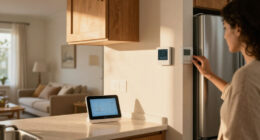
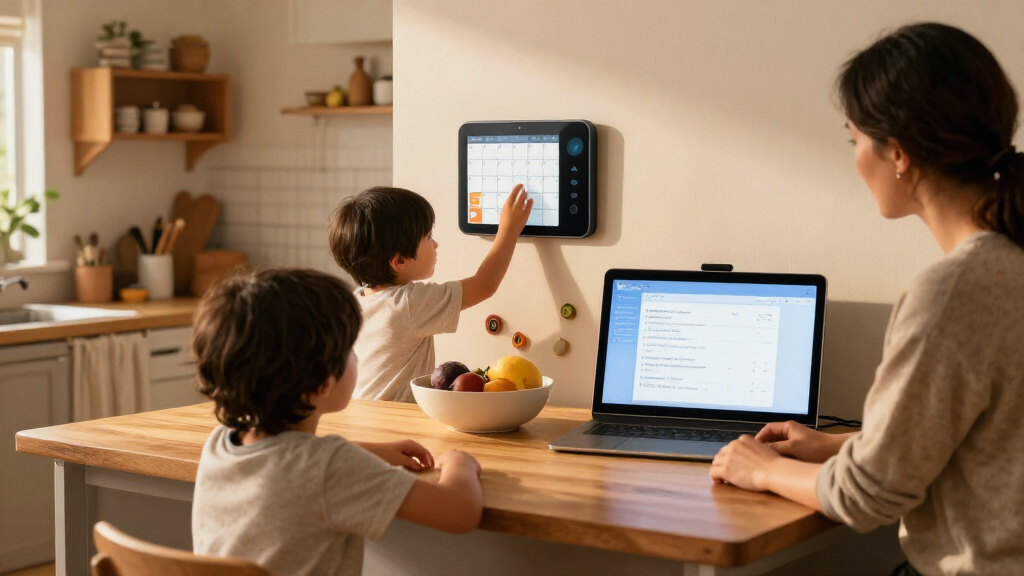
Both displays are designed to remain available for shared use, with interfaces for tasks such as checking a calendar or controlling connected home devices. The report says they can be used without entering a PIN or dismissing a screensaver before interacting with them. Amazon’s Echo Show 16 also offers a more tablet-style interface, including calendar and smart-home dashboard options, and a meal-planning feature on its Family Management home screen.
The products differ in how they connect household activity to personal information. Amazon says its Echo Show 16 can be set up without a phone, though a phone can help. Apple’s HomeView is more closely tied to the iPhone: the report says it has some built-in apps but relies on the phone to run others. In an Apple demonstration, Siri used information from messages to anticipate a friend’s arrival and turn on a coffee machine. That was a company demo, not an independently verified description of routine performance.
The pitch is for a device that puts household information and connected-home controls somewhere everyone can reach, instead of leaving a calendar, grocery list or meal plan on one person’s phone. The report argues that this could help address a familiar problem in busy homes: one person often carries much of the mental load of keeping track of shared tasks.
The higher prices make the change consequential for shoppers. The report compares the new models with 2023 devices that cost $85 for an Echo Show 5 and $99 for a Nest Hub. HomeView costs substantially more than those earlier examples, and Echo Show 16 is more expensive still. Whether the new hardware and household features justify the cost will depend on how well the screens work in daily use, not just what they showed in demonstrations.
A fixed, shared display could also be more practical for some homes than a tablet that moves between rooms and needs charging. The reviewer points to multiuser support and a screen that stays in place as potential advantages. Those are the reviewer’s assessment of the devices’ promise; the report does not establish that either product will solve household coordination problems for every family.
Products Worth Considering

EGO Power+ 9‑Gallon Wet/Dry Shop Vacuum with Remote Control (WDV0900) – Battery Not Included

WORX 20V Cordless Oscillating Multi-Tool WX698L

DEWALT 20V MAX 1/4-Inch Impact Driver Kit with Battery and Charger (DCF787D1)
As an affiliate, we earn on qualifying purchases.
From Smart Displays to Home Hubs
The report follows an earlier critique by its author. Three years before these launches, the reviewer wrote that smart displays were stuck between smart speakers and tablets, with limited hardware and software. The author also outlined features the category needed, including more capable components and an interface suited to shared use.
Other products have tried to fill parts of that role. The report cites the popularity of Skylight Calendar devices as evidence of demand for a communal household screen. It also describes the Google Pixel Tablet as a smart-display and tablet hybrid that disappointed the reviewer because of its detachable screen and limited smart-home support. Google reportedly canceled a successor 18 months later, the report says.
The HomeView and Echo Show 16 are presented as different answers to the same gap. Apple’s approach relies more on a person’s iPhone and personal context; Amazon’s emphasizes a household device that can operate without a phone. The report’s conclusions are based on brief hands-on access, rather than a complete comparison of long-term use.
“These could finally turn the smart display into what it should have been all along: the family computer.”
— The Verge reviewer
Daily Performance Still Untested
The report is based on brief hands-on time, so it does not establish how reliably either display performs over weeks of household use. It offers no independent measurements of processing speed, display quality or voice-assistant accuracy, and does not assess whether the products’ shared features work smoothly across different users.
It also remains unclear how much of HomeView’s functionality is available to a household without a nearby, recognized iPhone, or how well Echo Show 16’s household-focused features handle individual preferences and privacy. Apple’s message-reading and arrival-prediction example was shown in a demonstration; the source does not verify how it behaves outside that setting. The report does not provide a full release schedule, availability details or a head-to-head test.
Full Reviews Will Test the Promise
The next useful milestone is extended testing of both products in real homes. That would show whether the displays are easy for multiple household members to use, whether their calendars and smart-home controls stay useful throughout the day, and whether their voice and presence features work as shown in demonstrations.
For buyers, the choice will also depend on whether they want a screen that is closely integrated with an iPhone or a household device that can be set up without one. The source does not specify when fuller reviews or additional availability information will appear. Until those details and longer-term results are available, claims about the displays as family hubs remain promising but preliminary.
Key Questions
What are the HomeView and Echo Show 16?
They are new smart displays from Apple and Amazon. The report describes them as screens for shared household tasks, including calendars, meal planning and smart-home controls.
How much do the two devices cost?
The report lists the Apple HomeView at $299 and the Amazon Echo Show 16 at $499.99.
How do Apple’s and Amazon’s approaches differ?
The report says HomeView is closely tied to the iPhone and can use personal information through it. Echo Show 16 is designed to serve the household and can be set up without a phone, although a phone may help.
Have the devices been fully tested?
No. The report is based on brief hands-on time, and its reviewer said proper testing is still needed. Everyday reliability and the performance of the demonstrated features remain unconfirmed.
Source: theverge.com