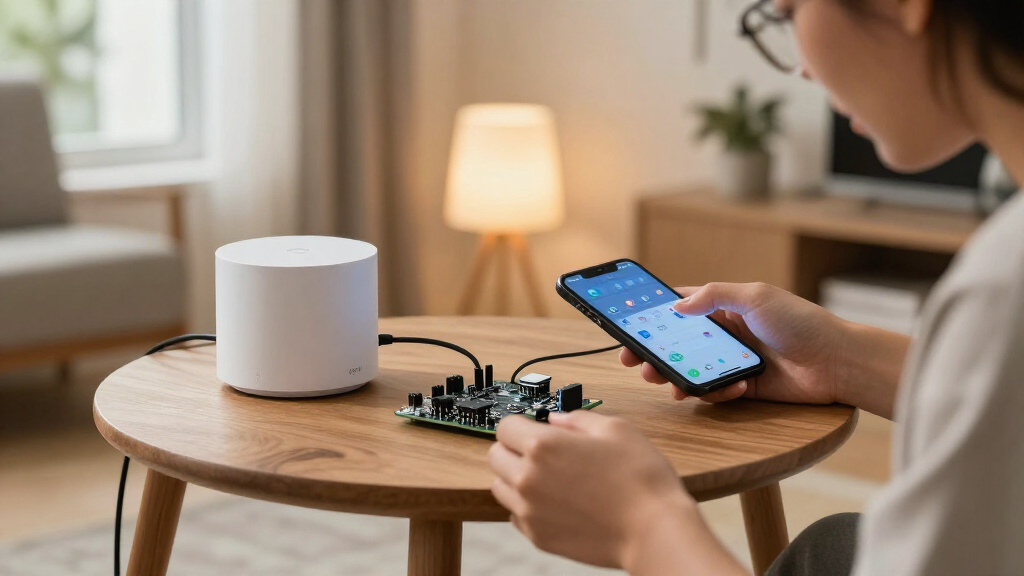

TL;DR
ESPHome 2026.11 adds experimental OpenThread Border Router support for compatible ESP32 hardware, plus USB audio hosting and a Sendspin source role for streaming audio to Music Assistant. The release is available now, but the router implementation lacks some standard features, including credential sharing, and remains experimental.
ESPHome 2026.11 adds experimental OpenThread Border Router (OTBR) support for compatible ESP32 setups, alongside USB audio hosting and a new Sendspin source role. The update gives users a do-it-yourself route to Thread networking and synchronized audio, though the border-router feature is still under development and lacks some standard capabilities.

Get home appliances delivered free with Prime
- Fast, free delivery on millions of items
- Prime Video, Amazon Music and more included
- Member-only deals all year
The new OTBR component requires ESP-IDF 5.5.5 or newer and IPv6 enabled. It can run on a single ESP32-C5 or ESP32-C6 board, or use a host such as an ESP32-S3 connected over UART to a separate Thread radio co-processor. Supported co-processor options listed in the report include the ESP32-H2 and chips from Nordic and Silicon Labs. Ethernet is supported as well as Wi-Fi, and a wired connection can be prioritized for backhaul.
The release also adds a USB Audio Class host for ESP32 chips with USB OTG: the ESP32-S2, S3, S31, P4 and H4. The component can connect standard USB sound cards, DACs, microphones and capture devices, including through hot-plugging. Separately, Sendspin gains a source role, allowing an ESPHome device to send captured audio to a Music Assistant server. Together, the features can connect sources such as a CD player or turntable to a synchronized audio setup.
Matter Alpha reports that tests with an ESP32-C6 development board and an ESP32-S3 paired with an ESP32-H2 ran the new router component reliably and sent diagnostic information to Home Assistant through its ESPHome integration. These were reported test results, not a guarantee of performance across all board combinations. The report says demo configurations are available on GitHub and that Home Assistant is not required to deploy the router feature.
Lower-Cost Routes to Thread and Audio
The additions put Thread networking and open audio tools within reach of people willing to configure inexpensive microcontroller boards, rather than relying solely on a commercial hub or a closed multi-room audio product. That could give smart-home users another way to build local infrastructure and connect devices across systems.
The practical reach is not yet equivalent to a finished commercial router or audio product. The OTBR feature is experimental, and users must choose compatible hardware and manage setup themselves. Still, support for multiple board arrangements and Ethernet gives developers and hobbyists more options to test Thread networks and audio integrations using open protocols.
Products Worth Considering

Greenworks 40V Cordless Brushless Leaf Blower with 4.0Ah Battery and Charger

Greenworks 80V Cordless Brushless Leaf Blower with 2.5 Ah Battery and Charger

EGO Power+ 56V Cordless Leaf Blower, 880 CFM, with Two 4.0Ah Batteries
As an affiliate, we earn on qualifying purchases.
From OpenThread Support to Routing
ESPHome already supported OpenThread connectivity for devices and over-the-air updates. The 2026.11 release extends that work by adding the ability for supported ESP32 configurations to act as a border router, which connects a Thread network to other IP networks. The change is therefore an expansion of existing protocol support, not a claim that every ESP32 board can become a router.
The report links the release to the Open Home Foundation, which maintains ESPHome, Home Assistant and Sendspin. Its stated approach emphasizes local control and interoperability rather than requiring users to rely on a single vendor’s cloud or product line. The update is available to users now; the report points people to update the ESPHome Firmware Builder to access the new features.
“The implementation is still experimental.”
— Matter Alpha report
Experimental Features and Missing Tools
ESPHome’s release notes, as described in the source report, do not establish when the OTBR component will leave experimental status or which missing features will be added next. The implementation currently lacks a REST API and web console, and ESPHome does not yet provide Thread credential sharing. Matter Alpha says its early testing found credential sharing could be added in a simple fork, but that is not the same as support in the released component.
Performance will depend on the hardware and network arrangement. The report cautions that a single board using 2.4 GHz Wi-Fi for its connection may face a performance trade-off because Wi-Fi and Thread share the same antenna. It says 5 GHz Wi-Fi on the ESP32-C5 or Ethernet can avoid that particular constraint. Independent testing across more devices and configurations, as well as details about future feature support, remain unavailable in the source material.
Testing and Feature Development
Users can try the features by updating the ESPHome Firmware Builder and selecting compatible hardware. Those testing OTBR should check the ESP-IDF, IPv6 and radio requirements for their chosen setup, and should treat the component as experimental rather than a replacement for a fully supported commercial router.
The next milestones are not specified. Future ESPHome releases may address credential sharing, the missing management interfaces and other gaps, but the source report gives no schedule or confirmation. For now, developers and users can evaluate the release’s configurations and provide feedback as the project’s support develops.
Key Questions
Can any ESP32 board become a Thread border router with ESPHome 2026.11?
No. The experimental feature requires a compatible setup, including a supported ESP32-C5 or C6 for a single-chip option, or a host board paired with a Thread radio co-processor. It also requires ESP-IDF 5.5.5 or newer and IPv6 enabled.
Is ESPHome’s Thread border-router feature ready for general use?
It is available in the release but remains experimental. The source report lists missing features including a REST API, a web console and Thread credential sharing.
Does the new border router require Home Assistant?
No. According to the Matter Alpha report, ESPHome can operate as a standalone platform, and the router can be used with other ecosystems. The report says Home Assistant integration can provide diagnostic information, but it is not required to deploy the feature.
What does the USB audio update support?
It adds USB Audio Class hosting on ESP32 chips with USB OTG, including the S2, S3, S31, P4 and H4. Supported devices include standard USB sound cards, DACs, microphones and audio capture devices.
How does Sendspin fit into the audio changes?
Sendspin gains a source role that lets an ESPHome device stream captured audio to a Music Assistant server. Paired with USB audio support, it can connect physical audio sources to a synchronized whole-home setup.
Source: matteralpha.com