
TL;DR

Get home appliances delivered free — and shop member deals
- Fast, free delivery on millions of items
- Access to Prime Big Deal Days deals on October 6–7
- Prime Video, Amazon Music and more included
Most utilities charge less during off-peak hours—often 50-70% cheaper. By scheduling your EV and power tools to charge during these times, you can save hundreds annually. The trick is understanding your rate plan, using the right tools, and setting up automation.
Imagine plugging in your EV late at night, knowing you’re paying a fraction of the usual rate. It’s not just about saving money—it’s about smartly using your home’s energy. Off-peak rates can cut your charging costs in half or more, especially if you schedule carefully. If you’re ready to make your home smarter and your bills smaller, this guide is for you.
Charging your EV or tools when electricity is cheapest is one of the easiest ways to cut costs. But it’s not just about plugging in. It’s about understanding your utility’s rate plan, setting up the right timers or automation, and knowing when and how to charge without sacrificing convenience or battery health. Let’s dive into how you can do all that, starting today.
Check your utility’s rate plan to identify off-peak hours and potential savings.
Use your EV’s app, smart chargers, or timers to automate charging during low-cost windows.
Stagger multiple tool chargers with timers or load management to avoid demand charges.
Charging during off-peak hours is generally better for your battery’s health and longevity.
Stay informed about new tech like V2G and dynamic tariffs that can further optimize your energy use and savings.
Scheduling EV & Tool Charging for Off-Peak Electricity Rates
Charging when electricity is cheapest can cut energy costs in half—or better. Decode your rate plan, automate the low-cost window, stagger workshop loads, and wake up with every battery ready.
Know exactly when cheap power starts
Your bill or utility portal reveals the schedule. Look beyond the headline rate: weekends, seasonal windows, EV programs, demand charges, and dynamic pricing can all change the best time to charge.
Time of use
Fixed daily windows. Schedule charging after the off-peak rate begins and stop before the morning transition.
EV-specific rate
A separate tariff or submeter can offer deeper overnight discounts for vehicle charging.
Demand charge
The highest short burst of power may set a monthly fee. Staggering chargers helps flatten that spike.
Dynamic pricing
Hourly or event-based prices reward flexible charging that responds automatically to real-time signals.
Automate once. Save every night.
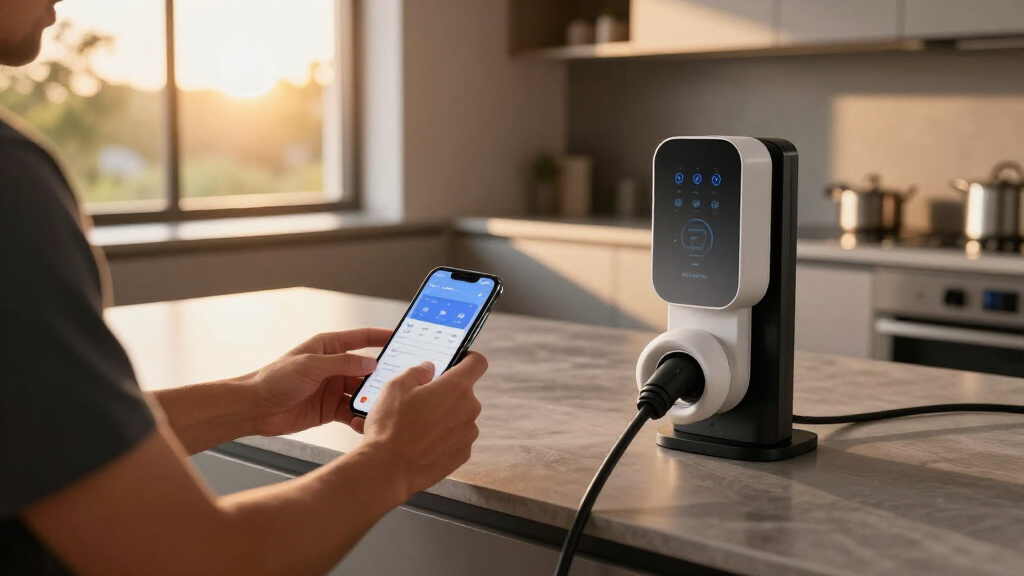
Choose the simplest control point that fits the load. Vehicle settings cost nothing; connected hardware adds monitoring, utility integration, load sharing, and protection against simultaneous demand peaks.
Vehicle app
Set a charging window or departure time using native controls. No extra hardware required.
Smart EVSE
Use connected Level 2 charging for schedules, energy data, load sharing, and utility enrollment.
Tool timers
A $15–30 timer, monitored smart plug, or power strip can shift a bank of small chargers overnight.
Load manager
Pause or throttle charging when household demand rises, often avoiding a costly panel upgrade.
One schedule can recover hundreds
For an EV using 3,400 kWh per year, moving from a $0.25 peak rate to a $0.10 off-peak rate lowers annual charging cost by roughly $510—before incentives or managed-charging credits.
Illustrative annual EV cost
Match the tool to the charging job
Start with native scheduling when possible. Add connected hardware when you need energy records, several coordinated chargers, utility control, or automated protection against high household demand.
| Control method | Best for | Scheduling | Energy data | Load sharing | Typical outlay |
|---|---|---|---|---|---|
| Vehicle-native app | One EV, simple tariff | ✓ | ~ | ✗ | Included |
| Smart Level 2 EVSE | Detailed control and utility programs | ✓ | ✓ | ~ | Moderate |
| Smart plug or timer | Tool packs and small equipment | ✓ | ~ | ✗ | $15–30 |
| Load manager | Multiple high-power loads | ✓ | ✓ | ✓ | Higher |
| Utility managed charging | Maximum automation and incentives | ✓ | ~ | ✓ | Often rewarded |
A lower bill can support a healthier battery
Scheduling is not only about price. Finishing near departure reduces time spent at a high state of charge, while plugged-in preconditioning can warm or cool the cabin using grid power.
The everyday 80% target
For vehicles that recommend it, an approximately 80% daily limit reduces prolonged high-charge stress. Follow the manufacturer’s instructions for your specific battery chemistry.
The cheapest window is becoming dynamic
Solar-heavy grids may offer their lowest-cost or cleanest power around midday, not overnight. Telematics, bidirectional charging, and aggregated grid services are making schedules more responsive.
Utility control, fewer barriers
Telematics-based programs can schedule through the vehicle itself and may provide monthly credits without requiring a specific charger brand.
Your EV becomes storage
Bidirectional vehicles can charge when power is cheap, then support the home or export energy during high-cost periods.
Automation follows price
Connected systems increasingly react to real-time prices, renewable supply, grid events, and the driver’s required departure range.
A five-step charging playbook
The highest-value setup is the one that works without daily attention. Verify the tariff, set a conservative schedule, confirm the first few sessions, then let the automation run.
Typical estimated monthly saving per EV. Your result depends on local rates, annual mileage, vehicle efficiency, charging losses, and how consistently charging moves out of peak periods.
Decode Your Utility’s Rate Plans — Know When Off-Peak Rates Hit
The first step is understanding your electricity rate plan. Utilities often have specific peak and off-peak windows, which can vary widely. Recognizing these time frames is crucial because it allows you to align your charging schedule with the lowest rates, maximizing savings. For instance, if your utility’s off-peak hours are from 10 p.m. to 6 a.m., charging during this window can significantly reduce costs. However, if you miss these windows or if your schedule doesn’t match, you might not achieve the full savings potential. Some utilities also offer different rate plans based on your energy consumption patterns or specific programs for EV owners, which can further lower costs. By carefully reviewing your bill or online account, you can identify your plan’s structure, ensuring your charging times are optimized. Understanding when rates change helps you avoid accidental charging during expensive peak hours, which could negate the savings you seek. This knowledge empowers you to make informed decisions that balance cost savings with your daily routines and vehicle needs.
As an affiliate, we earn on qualifying purchases.
Pick the Right Tools — How to Automate Charging Without Hassle
Once you understand when rates are lowest, the next step is implementing tools that allow you to automate your charging process. EVs typically come with apps or onboard settings that enable scheduled charging, but these features may have limitations depending on the vehicle model. Upgrading to smart chargers like ChargePoint or JuiceBox transforms your setup, providing precise control over charging times, energy monitoring, and integration with utility programs. This automation reduces the cognitive load—no need to manually start and stop charging—ensuring you always capitalize on off-peak rates without remembering to do so. For power tools and smaller equipment, simple timers or smart plugs are effective, inexpensive options that can delay charging until the designated off-peak window. Load management devices, such as smart circuit splitters, help coordinate multiple chargers or tools, preventing overloads and demand charges that can significantly inflate your bills. These tools work together to create a seamless, automated system that aligns your energy use with the cheapest rates, minimizing effort while maximizing savings. The tradeoff is investing in some hardware upfront, but the long-term convenience and savings typically outweigh the initial cost.
As an affiliate, we earn on qualifying purchases.
Crunch the Numbers — How Much Can You Really Save?
Understanding the potential savings from off-peak charging isn’t just about crunching numbers; it’s about recognizing how these savings impact your overall energy costs and lifestyle. An average EV consumes about 3,400 kWh annually, but this varies based on driving habits and vehicle efficiency. Charging during peak hours at around $0.25 per kWh can cost roughly $850 per year, which adds up quickly. Switching to off-peak rates at approximately $0.10 per kWh reduces this cost to about $340, saving you roughly $500 annually per vehicle. These savings become even more significant if you own multiple EVs or operate a workshop with several tools charging simultaneously. The key is that these savings are not just monetary—by shifting energy use to off-peak times, you reduce strain on the grid, decrease demand charges, and promote a more sustainable energy system. Additionally, the flexibility of scheduling helps prevent the need for costly upgrades or infrastructure changes. This comprehensive approach to cost management emphasizes that smart scheduling isn’t just about saving a few dollars—it’s about optimizing your entire energy footprint.
As an affiliate, we earn on qualifying purchases.
Battery Care & Peak Charging — Why Scheduling Is a Win-Win
Scheduling your EV’s charging cycles plays a critical role in prolonging your battery’s lifespan. Charging to around 80% during off-peak hours and avoiding high-stress rapid charging cycles reduces battery degradation. High charging rates and high states of charge can accelerate wear, leading to earlier replacement costs. By preconditioning your vehicle—warming or cooling the cabin during off-peak hours—you also reduce the strain on the battery, maintaining optimal performance and range. In cold climates, scheduling charging to finish just before departure ensures your vehicle is ready without sitting at a high state of charge overnight, which can be stressful for the battery. This approach not only preserves battery health but also enhances vehicle readiness and comfort. The secondary benefit is financial: extending battery life delays the need for costly replacements and maintains your vehicle’s resale value. Overall, thoughtful scheduling aligns with both your financial and environmental goals, making it a smart, long-term investment in your EV’s health.
As an affiliate, we earn on qualifying purchases.
Latest Tech & Trends — What’s Changing in Smart Charging
The world of EV charging is rapidly evolving, driven by technological advances and changing energy markets. Utilities now employ vehicle telematics and smart apps—such as Octopus Energy’s Intelligent tariffs—to automate charging based on real-time price signals, making energy management more dynamic and responsive. Vehicles like the Ford F-150 Lightning support bidirectional V2G (Vehicle-to-Grid), which allows your EV to supply power back to your home during peak hours, earning credits and reducing your overall energy costs. This capability transforms your vehicle from a simple energy consumer to an active participant in grid balancing, improving efficiency and resilience. Recent standards like FERC Order 2222 facilitate market access for aggregated energy resources, meaning your EV could soon participate in broader grid services. AI-driven apps are also emerging, enabling fully automated, adaptive scheduling that responds to real-time grid conditions with minimal user input. These innovations not only optimize your energy costs but also contribute to a more sustainable and resilient energy infrastructure, empowering homeowners with new ways to save and support the grid.
Your Questions Answered — Clearing Up Common Concerns
- How much will I save? Estimates range from $25–$50 monthly per EV, but actual savings depend on your usage patterns and local rates. The more consistent your off-peak charging, the greater the cumulative savings, making it a worthwhile investment in both time and money.
- Do I need a smart charger? Not necessarily. Many EVs have built-in scheduling features that can suffice for basic off-peak charging. However, smart chargers unlock advanced control, real-time energy monitoring, and integration with utility programs, enabling more precise and automated management that maximizes savings and convenience.
- Will charging off-peak harm my battery? No—charging during off-peak hours generally reduces stress on your battery compared to rapid or high-usage charging. Maintaining charge levels between 20% and 80% during these times helps preserve battery health, avoiding the high-voltage stress associated with full charges or rapid charging sessions.
- What if I need to charge earlier than scheduled? Most systems allow manual overrides or immediate charging options. This flexibility ensures your vehicle remains ready when needed, without sacrificing the benefits of scheduled off-peak charging for routine use.
- Can renters do this? Yes, renters can benefit from managed charging through workplace chargers, public stations with off-peak rates, or by advocating for smart charging solutions in multi-unit dwellings. Coordination with property managers and utility programs can help facilitate this, making off-peak scheduling accessible to a broader audience.
Conclusion
Scheduling your EV and tool charging during off-peak hours transforms a routine task into a smart savings strategy. It’s simple, effective, and increasingly accessible. Think of it as giving your home a small, steady boost that pays off in dollars and long-term battery health.
Next time you plug in, ask yourself: is this the best time to charge? With a little setup, the answer can be a resounding yes—and your wallet will thank you.
Fall yard work Picks
leaf blowers
As an affiliate, we earn on qualifying purchases.



![[Fact Check] Lee’s Claim Blaming Oh For Seoul Home Prices? - 최보식의언론](https://timerone.com/wp-content/uploads/2026/09/fact-check-lee-s-claim-blaming-oh-for-seoul-home-prices-featured-260x140.jpg)