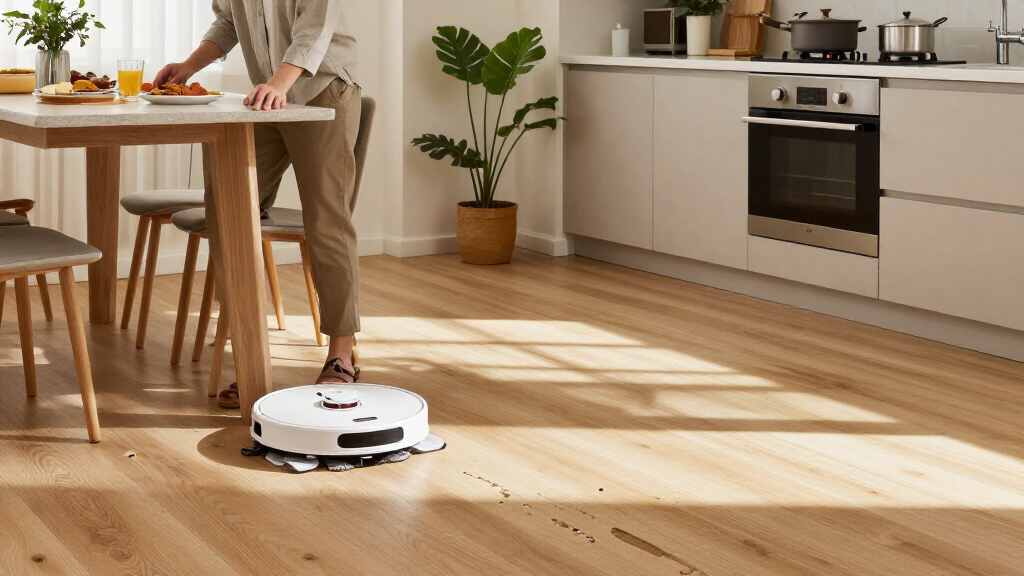

Robot vacuum and mop combos can cut daily floor-care work, but the right choice depends on how much you want the robot and its dock to handle. From the listed models, I’d name the eufy E25 a standout overall on paper for its high stated suction and HydroJet roller mop, while the Roborock Qrevo S Pro stands out for shoppers prioritizing a feature-rich dock and Shark PowerDetect AV2800ZE for self-emptying convenience. Those strengths come with tradeoffs: more automated docks need more upkeep and space, while simpler or less-documented options may leave more mop work to you. Suction figures alone also don’t tell you how well a robot handles edges, obstacles, or dried-on spills. Read on for the full comparison, ranking logic, and guidance on matching a combo to your home.

Get home appliances delivered free with Prime
- Fast, free delivery on millions of items
- Prime Video, Amazon Music and more included
- Member-only deals all year
Complete the kit


Key Takeaways
- The listed eufy E25 stands out for pet-focused mopping: its 20,000 Pa claim and HydroJet roller mop point to a different cleaning approach from models that rely on a simpler mop attachment, though the listed specs alone don’t establish real-world results.
- Dock features separate convenience from hands-on care: the Shark AV2800ZE emphasizes a 60-day self-emptying base, while several Roborock and iRobot picks name self-emptying or AutoWash docks; buyers should check exactly which mop tasks each dock automates.
- High suction claims are not directly comparable cleaning scores: the list includes models claiming 18,500 Pa, 15,000 Pa, 5,200 Pa, and 5,000 Pa, but brush design, floor type, navigation, and pickup testing matter too.
- Several entries share a product family or model name: the two Qrevo S Pro listings appear to be duplicates, so shoppers should verify the exact configuration rather than treat them as distinct choices.
- Budget-friendly simplicity can mean more manual work: the 5,000 Pa and 5,200 Pa combo listings give fewer details about advanced dock care, making them more suitable for buyers who can accept a hands-on mop routine and verify included features before purchase.
| Robot Vacuum and Mop Combo with 5000 Pa Suction |  | Best Basic Pick | Suction power: 5,000 Pa | Functions: Sweeping, vacuuming, and mopping | Cleaning modes: Auto, Edge, Spot, Schedule | VIEW LATEST PRICE | See Our Full Breakdown |
| eufy E25 Robot Vacuum and Mop for Pet Hair, 20,000 Pa, HydroJet Roller Mop |  | Best for Pet Hair and Active Mopping | Maximum suction: 20,000 Pa | Mop system: HydroJet roller mop | Runtime: Up to 125 minutes in standard vacuum-and-mop mode | VIEW LATEST PRICE | See Our Full Breakdown |
| Shark PowerDetect Robot Vacuum and Mop Combo with 60-Day Self-Emptying Base (AV2800ZE) |  | Best for Low-Touch Maintenance | Model: AV2800ZE | Navigation: 360° LiDAR and 3D sensors | Self-emptying capacity: Up to 60 days | VIEW LATEST PRICE | See Our Full Breakdown |
| Roborock Q7 M5+ Robot Vacuum and Mop with Self-Emptying Dock |  | Best Value for Mapping and Longer Runs | Maximum suction: 10,000 Pa | Dust bag capacity: 2.7 L | Estimated self-emptying interval: Up to 7–9 weeks | VIEW LATEST PRICE | See Our Full Breakdown |
| eufy C28 Robot Vacuum and Mop with 15,000 Pa Suction |  | Best Camera-Free Roller Mop | Suction power: 15,000 Pa | Mop system: Self-cleaning HydroJet roller; 28 cm wide, 270 RPM | Dust bag capacity: 3 L | VIEW LATEST PRICE | See Our Full Breakdown |
| Roborock Qrevo S Pro Robot Vacuum and Mop with 18,500 Pa Suction |  | Best for Hands-Off Mop Care | Suction power: 18,500 Pa | Navigation: LiDAR | Mop system: Dual liftable spinning mops | VIEW LATEST PRICE | See Our Full Breakdown |
| Roborock Qrevo S Pro Robot Vacuum and Mop with 18,500 Pa Suction |  | Best for Low-Clearance Furniture | Suction power: 18,500 Pa | Robot height: 3.8 inches | Navigation: LiDAR | VIEW LATEST PRICE | See Our Full Breakdown |
| Kilgone Robot Vacuum and Mop Combo with 360° LiDAR Mapping and Auto-Empty Dock |  | Best for Multi-Floor Mapping | Mapping: 360° LiDAR; saves up to 5 maps | Dimensions: 12.6 × 12.6 × 3.64 inches | Dock dust capacity: 2.5 L | VIEW LATEST PRICE | See Our Full Breakdown |
| Kilgone SDL40 Robot Vacuum and Mop with Self-Emptying Base |  | Best for Flexible Wi-Fi Support | Navigation: LiDAR mapping | Mapping capacity: Up to 5 maps | Dock dust bag: 2.5 L; up to 90 days of debris | VIEW LATEST PRICE | See Our Full Breakdown |
| Roborock Qrevo 2 Pro Robot Vacuum and Mop |  | Best for Long-Running, Edge-Focused Cleaning | Suction power: 20,000 Pa | Battery life: Up to 253 minutes | Navigation: LiDAR | VIEW LATEST PRICE | See Our Full Breakdown |
| iRobot Roomba Plus 415X Robot Vacuum and Mop Combo with AutoWash Dock |  | Best for Pet Hair and Low-Touch Mop Care | Suction power: 20,000 Pa | Cleaning modes: Vacuum-only, mop-only, vacuum and mop, vacuum then mop | Dock: AutoWash Dock with debris emptying, mop washing, and heat drying | VIEW LATEST PRICE | See Our Full Breakdown |
| iRobot Roomba 105 Combo Robot Vacuum and Mop with AutoEmpty Dock |  | Best for Straightforward, Scheduled Cleaning | Navigation: ClearView LiDAR mapping | Surfaces: Carpet and hard floor | Cleaning modes: Vacuum, mop, or vacuum and mop | VIEW LATEST PRICE | See Our Full Breakdown |
| iRobot Roomba Plus 405 Combo Vacuum and Mop Robot with AutoWash Dock |  | Best for Hands-Off Spinning-Pad Mopping | Model: Roomba Plus 405 (G181) | Dock: AutoWash dock with auto-emptying, mop-pad washing, and drying | Debris collection: Up to 75 days | VIEW LATEST PRICE | See Our Full Breakdown |
| ROPVACNIC Robot Vacuum and Mop Combo, 5200Pa Suction |  | Best for Flexible Controls on Hard Floors | Model: S1 | Maximum suction: 5,200 Pa | Water adjustment: Four stages | VIEW LATEST PRICE | See Our Full Breakdown |
| robot vacuum and mop combo | Navigation |
|---|---|
| Robot Vacuum and Mop Combo wit | Zig-zag cleaning with obstacle avoidance |
| eufy E25 Robot Vacuum and Mop | Laser-guided; stores up to 5 floor plans |
| Shark PowerDetect Robot Vacuum | 360° LiDAR and 3D sensors |
| Roborock Q7 M5+ Robot Vacuum a | PreciSense LiDAR |
| eufy C28 Robot Vacuum and Mop | Camera-free LiDAR |
| Roborock Qrevo S Pro Robot Vac | LiDAR |
| Roborock Qrevo S Pro Robot Vac | LiDAR |
| Kilgone Robot Vacuum and Mop C | — |
| Kilgone SDL40 Robot Vacuum and | LiDAR mapping |
| Roborock Qrevo 2 Pro Robot Vac | LiDAR |
| iRobot Roomba Plus 415X Robot | LiDAR mapping and obstacle recognition |
| iRobot Roomba 105 Combo Robot | ClearView LiDAR mapping |
| iRobot Roomba Plus 405 Combo V | ClearView LiDAR mapping |
| ROPVACNIC Robot Vacuum and Mop | — |
More Details on Our Top Picks
Robot Vacuum and Mop Combo with 5000 Pa Suction
This is the simplest choice in this group for buyers who want vacuuming and mopping in one compact robot without adding an automated maintenance station. Its 5,000 Pa suction, carpet boost, and tangle-free design give it a useful mix for everyday debris and pet hair, while zig-zag cleaning with obstacle avoidance helps cover open rooms. Compared with the Roborock Q7 M5+, it has less suction and no self-emptying dock, but it is also a more straightforward option for someone who prefers basic scheduled cleaning over a larger station and app-led mapping features. The main tradeoff is limited detail about the mop setup: water tank capacity is unspecified, so buyers cannot gauge how often refills may be needed. It also requires 2.4 GHz Wi-Fi for app connection.
Pros:- Combines sweeping, vacuuming, and mopping in one device.
- Tangle-free design is intended to reduce pet-hair blockages.
- Carpet suction boost and up to 150 minutes of runtime support mixed-floor routines.
- Offers app, touchpad, and voice control with four cleaning modes.
Cons:- No self-emptying or automatic mop-washing station is listed.
- Water tank capacity is not specified.
- App connectivity is limited to 2.4 GHz Wi-Fi.
Best for: First-time combo buyers in smaller or moderately sized homes who want app or voice scheduling and pet-hair-focused design without a self-emptying station.
Not ideal for: Buyers who want hands-off mop washing, self-emptying, detailed map controls, or clear information about mopping capacity.
- Suction power:5,000 Pa
- Functions:Sweeping, vacuuming, and mopping
- Cleaning modes:Auto, Edge, Spot, Schedule
- Navigation:Zig-zag cleaning with obstacle avoidance
- Runtime:Up to 150 minutes
- Coverage:Up to 1,800 sq ft
- Wi-Fi requirement:2.4 GHz
- Dimensions:11 x 11 x 3.19 in
Our verdict“Choose this basic combo for routine mixed-floor cleaning and pet hair if you do not need an automated dock or advanced mapping.”
eufy E25 Robot Vacuum and Mop for Pet Hair, 20,000 Pa, HydroJet Roller Mop
The E25 is the strongest fit here for homes where mopping performance and pet-hair management matter more than a long interval between robot runs. Its HydroJet roller refreshes with clean water during cleaning, while the all-in-one station empties dust, washes and hot-air dries the mop, and refills water. That adds more maintenance automation than the Roborock Q7 M5+, whose listed dock handles dust but not mop washing. The E25 also stores up to five floor plans, a useful advantage for multi-level homes. Its 10.8 mm mop lift, however, limits carpet clearance, so it suits hard floors and short carpet better than homes with plush rugs. Runtime reaches 125 minutes in standard vacuum-and-mop mode, shorter than the Q7 M5+’s listed 150 minutes, and connectivity is 2.4 GHz only.
Pros:- HydroJet roller refreshes with clean water during mopping.
- Station empties dust, washes and hot-air dries the mop, and refills water.
- Anti-tangle brushes and 20,000 Pa suction target pet hair and debris.
- Laser-guided navigation stores up to five floor plans.
Cons:- The 10.8 mm mop lift offers limited clearance over carpets.
- Up to 125 minutes of standard vacuum-and-mop runtime is shorter than the Roborock Q7 M5+ listing.
- Wi-Fi connectivity is limited to 2.4 GHz.
Best for: Pet owners with mostly hard flooring who want a roller mop refreshed during cleaning and a station that handles dust, mop washing, drying, and water refills.
Not ideal for: Homes with thick carpets or buyers who need a longer listed runtime and broad carpet clearance while the mop is attached.
- Maximum suction:20,000 Pa
- Mop system:HydroJet roller mop
- Runtime:Up to 125 minutes in standard vacuum-and-mop mode
- Dust bag capacity:3 L
- Water tank capacity:2.5 L
- Mop lift:10.8 mm
- Navigation:Laser-guided; stores up to 5 floor plans
- Threshold climbing:21 mm
- Noise level:57 dB; up to 61 dB in max mode
Our verdict“Pick the E25 for pet-heavy, mostly hard-floor homes that value active roller mopping and automated station care over carpet clearance.”
Shark PowerDetect Robot Vacuum and Mop Combo with 60-Day Self-Emptying Base (AV2800ZE)
The Shark PowerDetect stands out for buyers who want the dock to handle more than dust: its NeverTouch Pro Base holds debris for up to 60 days, refills water for up to 30 days, and washes and dries the pad after each cleaning. That makes it a more hands-off maintenance choice than the Roborock Q7 M5+, whose listed self-emptying interval is 7–9 weeks but does not include automatic pad care. Shark’s LiDAR and 3D sensors support mapping, obstacle avoidance, and targeted cleaning, while its sensing system adjusts cleaning for debris, stains, and edges. The tradeoff is that the mop is meant for hard floors and lifts above carpets during mopping, so it is not a one-pass wet-cleaning solution for every surface. Scheduling and targeted controls also depend on the SharkClean app.
Pros:- Base provides up to 60 days of debris capacity and up to 30 days of water refills.
- Mopping pad is automatically washed and dried after each cleaning.
- LiDAR and 3D sensors support mapping, obstacle avoidance, and targeted cleaning.
- Sensors adjust cleaning response to debris, stains, and edges.
Cons:- Mopping is intended for hard floors, with the pad lifted above carpets.
- Scheduling and targeted cleaning controls require the SharkClean app.
- The supplied product data does not specify suction power or runtime.
Best for: Busy households with a mix of carpet and hard flooring that want the dock to empty debris, replenish water, and wash and dry the mop pad.
Not ideal for: Buyers who want mop cleaning on carpet, prefer controls that do not rely on a smartphone app, or need specified suction and runtime figures before choosing.
- Model:AV2800ZE
- Navigation:360° LiDAR and 3D sensors
- Self-emptying capacity:Up to 60 days
- Water tank refills:Up to 30 days
- Mop-pad maintenance:Automatically washed and dried after each cleaning
- App:SharkClean
- Included mopping pads:3
- Recommended surfaces:Carpets and hard floors; mopping intended for hard floors
Our verdict“Choose the Shark for reduced dock maintenance across mixed-floor homes, provided you are comfortable managing its targeted controls through the app.”
Roborock Q7 M5+ Robot Vacuum and Mop with Self-Emptying Dock
The Q7 M5+ is a balanced pick for buyers who want mapped vacuuming, adjustable mopping, and extended dust storage without a station built around washing the mop. PreciSense LiDAR lays out efficient cleaning paths, while three water-flow settings let owners match mopping output to different hard floors. Its 2.7-liter sealed bag is estimated to last 7–9 weeks, and dual anti-tangle brushes are aimed at homes with shedding pets. Compared with the Shark PowerDetect, the Q7 M5+ lists a 150-minute battery life but does not include the Shark’s automatic mop washing, drying, or water refilling. That means less dock complexity, but more direct mop upkeep. The app also provides schedules, spot cleaning, and no-go zones; buyers who want automated pad care should look to the Shark or eufy E25 instead.
Pros:- PreciSense LiDAR supports mapped, optimized cleaning paths.
- Three water-flow settings allow mopping output to be adjusted.
- Dual anti-tangle brushes are designed to reduce pet-hair wrap.
- 2.7 L sealed dust bag is estimated to last up to 7–9 weeks.
Cons:- The dock is listed for dust emptying, not automatic mop washing or drying.
- Wi-Fi compatibility is limited to 2.4 GHz.
- The estimated time between emptying can vary with household use.
Best for: Pet owners who want LiDAR mapping, configurable water flow, and a self-emptying dock, and are willing to maintain the mop themselves.
Not ideal for: Buyers seeking automatic mop washing and drying, or those who want app connectivity on 5 GHz Wi-Fi.
- Maximum suction:10,000 Pa
- Dust bag capacity:2.7 L
- Estimated self-emptying interval:Up to 7–9 weeks
- Battery life:150 minutes
- Navigation:PreciSense LiDAR
- Water-flow settings:3
- Power levels:4
- Noise level:65 dB
- Wi-Fi compatibility:2.4 GHz only
Our verdict“Pick the Q7 M5+ for mapped cleaning, long listed runtime, and less frequent dust disposal if you are comfortable handling mop maintenance yourself.”
eufy C28 Robot Vacuum and Mop with 15,000 Pa Suction
The C28 combines camera-free LiDAR navigation with a self-cleaning HydroJet roller, making it a strong match for buyers who want active mopping without camera-based navigation. Its station empties dust, washes and dries the roller, and collects wastewater, while the DuoSpiral brush is designed to limit long-hair tangles. Compared with the eufy E25, the C28 lists lower suction at 15,000 Pa but offers a quieter stated operating level of 54.89 dB and a 140-minute battery life. Both share a 10.8 mm mop lift, so neither is the right pick for homes with high-pile carpet; the C28’s recommended surfaces are hard floors and short-pile carpets. Its 3 L dust bag and washable filter add practical details, though the bag still needs eventual replacement.
Pros:- HydroJet roller and station automate mop washing, drying, and wastewater collection.
- Camera-free LiDAR navigation maps around obstacles.
- DuoSpiral brush is designed to reduce tangles from long pet hair.
- Listed operating noise is 54.89 dB, with up to 140 minutes of battery life.
Cons:- The 10.8 mm mop lift and short-pile carpet recommendation limit carpet suitability.
- The 3 L dust bag will need eventual replacement.
- Listed suction is lower than the eufy E25’s 20,000 Pa.
Best for: Buyers with mostly hard floors who want a self-cleaning roller mop, camera-free mapped navigation, and pet-hair-focused brush design.
Not ideal for: Homes with thick or high-pile carpets, or buyers who want the highest listed suction among the roller-mop options.
- Suction power:15,000 Pa
- Mop system:Self-cleaning HydroJet roller; 28 cm wide, 270 RPM
- Dust bag capacity:3 L
- Battery life:140 minutes
- Navigation:Camera-free LiDAR
- Mop lift:10.8 mm
- Operating noise:54.89 dB
- Hot-air drying temperature:50°C
- Recommended surfaces:Hard floors, wooden floors, and short-pile carpets
Our verdict“Choose the C28 for camera-free navigation and automated roller-mop care in a mostly hard-floor home with short-pile rugs.”
Roborock Qrevo S Pro Robot Vacuum and Mop with 18,500 Pa Suction
I’d choose this Qrevo S Pro for a mixed-floor home where the mop needs more than a quick rinse between runs. Its dock washes the dual spinning mops with 167°F water, dries them with warm air, refills the robot, and handles dust in a 2.7 L bag. That level of dock care is a step beyond the simpler self-emptying setup on the Kilgone SDL40, while 18,500 Pa suction and liftable mops let it switch between carpets and hard floors. LiDAR mapping and anti-tangle brushes add useful support for routine whole-home cleaning. The tradeoff is a larger dock that needs a dedicated spot, and the listed noise figures conflict at 55 and 60 dB. I’d favor the Qrevo 2 Pro if longer runtime and stronger suction matter more than hotter mop washing.
Pros:- Dock washes mops with 167°F water, then dries them with warm air.
- 2.7 L dust bag and automatic water refilling reduce routine upkeep.
- Liftable spinning mops and carpet-specific settings support mixed flooring.
- Anti-tangle brush design is intended to reduce hair wrap.
Cons:- Multifunction dock needs more space than a basic charging base.
- Noise level is inconsistent in the supplied information: 55 dB versus 60 dB.
Best for: Households with a mix of carpet and hard flooring that want the dock to wash, dry, refill, and empty with little routine intervention.
Not ideal for: People with limited floor space for a multifunction dock or buyers who need a clearly stated noise level.
- Suction power:18,500 Pa
- Navigation:LiDAR
- Mop system:Dual liftable spinning mops
- Mop lift:10 mm
- Mop washing:167°F water
- Mop drying:113°F warm air
- Dust bag capacity:2.7 L
- Battery life:Up to 180 minutes
Our verdict“Choose this Qrevo S Pro if automated mop washing and drying matter more to you than the Qrevo 2 Pro’s longer runtime and higher stated suction.”
Roborock Qrevo S Pro Robot Vacuum and Mop with 18,500 Pa Suction
This version of the Qrevo S Pro is the clearest fit for homes with low furniture and objects scattered along cleaning routes: its listed 3.8-inch profile, LiDAR, and Reactive Tech obstacle avoidance are aimed at getting under furniture and routing around obstacles. It keeps the same 18,500 Pa suction, liftable spinning mops, and dock-based mop washing and drying as the other Qrevo S Pro listing, so its main distinction is the stated low profile and black finish—not a different cleaning system. Compared with the Kilgone SDL40, it adds hot-water mop washing and a more fully automated dock, though the Kilgone claims a longer interval between dust-bag changes. The Qrevo’s 2.4 GHz-only Wi-Fi can be limiting for some network setups, and its noise level is given as both 55 and 60 dB.
Pros:- Listed 3.8-inch height can help it reach beneath low furniture.
- Reactive Tech obstacle avoidance works alongside LiDAR navigation.
- Dock empties dust, washes mops with 167°F water, and dries them with warm air.
- Anti-tangle brushes and carpet settings support mixed-floor routines.
Cons:- Wi-Fi connectivity is limited to 2.4 GHz.
- The supplied noise figures conflict: 55 dB in the description and 60 dB in the specifications.
- The dock requires room for its dust bag and mop-care functions.
Best for: People with low sofas or beds and a mix of hard floors and carpet who want obstacle avoidance alongside an automated mop-care dock.
Not ideal for: Households using only 5 GHz Wi-Fi or buyers who need an unambiguous noise specification.
- Suction power:18,500 Pa
- Robot height:3.8 inches
- Navigation:LiDAR
- Obstacle avoidance:Reactive Tech
- Mop lift:10 mm
- Mop cleaning temperature:167°F
- Dust bag capacity:2.7 L
- Wi-Fi:2.4 GHz only
Our verdict“Pick this listing if low-clearance access and obstacle avoidance are priorities and your home network supports 2.4 GHz Wi-Fi.”
Kilgone Robot Vacuum and Mop Combo with 360° LiDAR Mapping and Auto-Empty Dock
I’d put this Kilgone SDL40 on the shortlist for a multi-level home: its 360° LiDAR mapping saves up to five maps, so you can keep separate layouts rather than remapping every floor. At 3.64 inches tall, it is also slightly lower-profile than the Qrevo S Pro listing at 3.8 inches, which may help it reach beneath some furniture. Its 2.5 L auto-empty dock is described as holding debris for up to 13 weeks, and the robot can recharge and resume during a run. But this is a more basic mop proposition than either Qrevo: the supplied details give three water-flow levels, not hot-water mop washing or drying. The 300 ml onboard bin is small, and the surface data is inconsistent—the recommendation lists glass even though the description focuses on hard floors.
Pros:- Stores up to five LiDAR maps for homes with multiple floors.
- Low 3.64-inch profile may fit beneath some furniture.
- 2.5 L dock is described as holding debris for up to 13 weeks.
- Recharges and resumes cleaning, with three water-flow settings.
Cons:- The 300 ml onboard dustbin is small if the robot must hold debris before dock emptying.
- No mop-washing or drying feature is listed, unlike the Roborock Qrevo S Pro.
- Supplied surface information is unclear: glass is listed despite the hard-floor-focused description.
Best for: People with multiple mapped floors who want scheduled vacuuming and light mopping, plus an auto-empty dock.
Not ideal for: Buyers seeking active mop washing and drying, or anyone who needs clear confirmation of supported floor surfaces.
- Mapping:360° LiDAR; saves up to 5 maps
- Dimensions:12.6 × 12.6 × 3.64 inches
- Dock dust capacity:2.5 L
- Robot dustbin capacity:300 ml
- Runtime:Up to 150 minutes
- Water-flow settings:3
- Wi-Fi:2.4 GHz and 5 GHz
- Filter:HEPA
Our verdict“Choose this Kilgone for multi-floor mapping and basic mopping, but look to a Qrevo model if automated mop washing is a priority.”
Kilgone SDL40 Robot Vacuum and Mop with Self-Emptying Base
This Kilgone SDL40 is the more straightforward pick for buyers who want LiDAR mapping, app control, and a self-emptying base without stepping up to the more involved mop-care dock on either Roborock Qrevo. Its stated 2.4 and 5 GHz Wi-Fi support offers more network flexibility than the 2.4 GHz-only Qrevo 2 Pro. The robot also supports up to five maps, runs for up to 150 minutes, and recharges and resumes. The description calls its mopping sonic, but the supplied specs do not detail the mop system, so I would not choose it expecting the same clearly specified dual spinning pads and hot-water washing found on the Qrevo S Pro. Its 300 ml dustbin is modest, and the 90-day dust-bag claim is an upper-bound estimate rather than a guarantee for every home.
Pros:- Supports both 2.4 GHz and 5 GHz Wi-Fi.
- LiDAR mapping can store up to five maps.
- 2.5 L dust bag is described as holding up to 90 days of debris.
- Anti-tangle main and side brushes are intended to reduce hair wrap.
Cons:- The 300 ml onboard dustbin has limited capacity.
- Mop washing and drying are not listed, unlike on the Roborock Qrevo S Pro.
- The sonic-mopping description does not specify mop mechanics or care functions.
Best for: Buyers who want multi-floor mapping, self-emptying, and dual-band Wi-Fi in a simpler vacuum-and-mop setup.
Not ideal for: People who want detailed mop-care automation or need a large onboard dustbin for runs between dock visits.
- Navigation:LiDAR mapping
- Mapping capacity:Up to 5 maps
- Dock dust bag:2.5 L; up to 90 days of debris
- Robot dustbin:300 ml
- Runtime:Up to 150 minutes
- Wi-Fi:2.4 GHz and 5 GHz
- Floor compatibility:Carpets and hard floors
- Filter:HEPA
Our verdict“Choose this SDL40 if dual-band Wi-Fi and multi-floor mapping matter more than a dock that actively washes and dries its mops.”
Roborock Qrevo 2 Pro Robot Vacuum and Mop
The Qrevo 2 Pro is the strongest fit here for large mixed-floor homes: it pairs 20,000 Pa suction with a stated 253-minute battery life, exceeding the Qrevo S Pro’s 18,500 Pa and 180-minute figures. Its dual spinning mops lift up to 15 mm, and the extending mop and reversible side brush are designed to clean close to walls and into corners. The dock also handles dust emptying, water refilling, mop washing, and warm-air drying, giving it a fuller care routine than either Kilgone SDL40. The tradeoffs are practical: Wi-Fi is limited to 2.4 GHz, and the 15 mm mop lift is still a clearance limit for taller carpet. Its 149°F mop-wash temperature is lower than the Qrevo S Pro’s listed 167°F, despite the Qrevo 2 Pro’s stronger suction and longer runtime.
Pros:- 20,000 Pa suction and up to 253 minutes of battery life suit longer cleaning sessions.
- Extending mop and reversible side brush target walls and corners.
- Dock empties dust, refills water, washes mops, and dries them with warm air.
- Dual anti-tangle brush system is designed to reduce hair wrap.
Cons:- Wi-Fi support is limited to 2.4 GHz.
- Mops lift only up to 15 mm, which may not clear taller carpet.
- Mop washing is listed at 149°F, below the Qrevo S Pro’s 167°F.
Best for: Owners of larger homes with mixed flooring who want long cleaning runs, edge-focused mopping, and an automated multifunction dock.
Not ideal for: Households that use only 5 GHz Wi-Fi or have thick carpet that may exceed the 15 mm mop-lift clearance.
- Suction power:20,000 Pa
- Battery life:Up to 253 minutes
- Navigation:LiDAR
- Mop system:Dual liftable spinning mops
- Mop lift:Up to 15 mm
- Edge cleaning distance:As close as 1.85 mm along walls
- Mop washing and drying:149°F wash; 113°F warm-air drying
- Wi-Fi:2.4 GHz only
Our verdict“Choose the Qrevo 2 Pro for longer runs and more edge-focused cleaning, provided its mop lift suits your carpets and your network supports 2.4 GHz.”
iRobot Roomba Plus 415X Robot Vacuum and Mop Combo with AutoWash Dock
The Roomba Plus 415X suits homes that need frequent vacuuming and mopping but not frequent dock maintenance. Its 20,000 Pa suction, tangle-free rubber brushes, and extending edge brushes target pet hair and wall edges, while SmartScrub adds extra effort on dried-on messes. The AutoWash Dock empties debris, washes pads, and heat-dries them at 113°F, so mop upkeep is more hands-off than with the Roomba 105 Combo, whose dock empties debris but does not wash and dry pads. LiDAR mapping, obstacle recognition, and a 10 mm mop lift help it work around household clutter and pass over some rugs. The tradeoff is that the stated 90-day debris interval is a maximum, not a guaranteed schedule, and battery life and water-tank capacity are not specified.
Pros:- Four modes allow vacuuming, mopping, or either sequence in one cleaning plan.
- Tangle-free rubber brushes are designed to collect pet hair with less brush maintenance.
- AutoWash Dock washes and heat-dries mop pads while also emptying debris.
- LiDAR, obstacle recognition, and a 10 mm mop lift support mapped cleaning around obstacles and rugs.
Cons:- The up-to-90-day debris interval varies with how often and how much the robot cleans.
- Battery life and water-tank capacity are not provided in the product details.
Best for: Pet owners who want a robot to vacuum and mop regularly, with dock-based pad washing and drying to reduce hands-on cleanup.
Not ideal for: Buyers who need confirmed battery-runtime or water-tank details, or whose rugs require more than 10 mm of mop clearance.
- Suction power:20,000 Pa
- Cleaning modes:Vacuum-only, mop-only, vacuum and mop, vacuum then mop
- Dock:AutoWash Dock with debris emptying, mop washing, and heat drying
- Debris emptying:Up to 90 days
- Mop-pad drying temperature:113°F
- Mop lift:10 mm
- Navigation:LiDAR mapping and obstacle recognition
- Brushes:Tangle-free rubber brushes and extending edge brushes
Our verdict“Choose the 415X if pet hair and automated mop-pad care matter more than having clearly stated runtime and tank capacity.”
iRobot Roomba 105 Combo Robot Vacuum and Mop with AutoEmpty Dock
The Roomba 105 Combo is the practical pick for buyers who want mapped vacuum-and-mop routines without a mop-washing dock. ClearView LiDAR supports room-specific scheduling, and the app lets you adjust suction, passes, and mopping rather than relying on a single default run. Its AutoEmpty dock stores debris for up to 75 days, and the dock bag is specified to trap 99% of allergens as small as 0.7 microns. Rug detection helps avoid wetting carpets during mop runs. Compared with the Roomba Plus 405, it skips automatic pad washing and drying, but its controls still cover targeted cleaning and separate or combined modes. The tradeoff is more manual mop-pad care, plus a 2.4 GHz Wi-Fi requirement and limits on which cleaning solutions are compatible.
Pros:- LiDAR mapping and room-specific schedules support targeted cleaning.
- Offers vacuum-only, mop-only, and combined cleaning modes.
- AutoEmpty dock stores debris for up to 75 days and uses a bag rated to trap 99% of allergens as small as 0.7 microns.
- App settings adjust suction, cleaning passes, and mopping, with robot-button and compatible voice-assistant controls.
Cons:- The AutoEmpty dock does not wash or dry the mop pad, leaving that care to the owner.
- Setup and operation require a 2.4 GHz Wi-Fi network.
- Compatible cleaning solutions are limited to those listed by iRobot.
Best for: Households that want LiDAR-mapped room schedules, adjustable cleaning settings, and a debris-emptying dock without paying for automated mop-pad washing.
Not ideal for: Buyers who want the dock to wash and dry mop pads, or whose home network does not support 2.4 GHz Wi-Fi.
- Navigation:ClearView LiDAR mapping
- Surfaces:Carpet and hard floor
- Cleaning modes:Vacuum, mop, or vacuum and mop
- Dock:AutoEmpty self-emptying dock
- Debris capacity duration:Up to 75 days
- Mopping:Microfiber mop pad with controlled water flow and SmartScrub
- Connectivity:2.4 GHz Wi-Fi
- Controls:App, robot buttons, and compatible voice assistants
Our verdict“Pick the Roomba 105 if mapped scheduling and debris auto-emptying matter more than automated mop-pad maintenance.”
iRobot Roomba Plus 405 Combo Vacuum and Mop Robot with AutoWash Dock
The Roomba Plus 405 makes the most sense for buyers who want mop-pad care handled at the dock and prefer active scrubbing over a basic wipe. Its DualClean spinning mop pads pair with SmartScrub, while automatic carpet lift helps keep the pads off carpet during a cleaning run. ClearView LiDAR maps the home, and four suction levels and targeted zones give more control than the simpler setup of the Roomba 105 Combo. The AutoWash dock empties debris and washes and dries the pads, reducing routine maintenance. Its stated four-week mopping capacity assumes only one run per week, though, so frequent mopping can mean more attention. The product details also do not give suction power or pad-drying temperature, making direct spec comparisons harder.
Pros:- DualClean spinning pads and SmartScrub are designed for more active hard-floor cleaning.
- Automatic carpet lift helps keep mop pads clear of carpet.
- AutoWash dock empties debris and washes and dries mop pads.
- LiDAR mapping, targeted zones, and four suction levels allow flexible cleaning plans.
Cons:- The four-week mopping duration is based on just one mopping run per week.
- Suction power and mop-pad drying temperature are not specified in the product details.
- Cleaning-solution use requires checking the manufacturer’s compatible-product list.
Best for: Owners of mixed hard-floor and carpet homes who want spinning-pad mopping, adjustable cleaning, and dock-based pad washing and drying.
Not ideal for: People who mop several times a week and expect the stated four-week dock interval to hold, or buyers who need published suction and drying-temperature figures.
- Model:Roomba Plus 405 (G181)
- Dock:AutoWash dock with auto-emptying, mop-pad washing, and drying
- Debris collection:Up to 75 days
- Mopping duration:Up to 4 weeks, based on 1 mopping run per week
- Navigation:ClearView LiDAR mapping
- Mop pads:DualClean spinning mop pads with automatic carpet lift
- Cleaning modes:Vacuum, mop, combo clean, vacuum then mop
- Suction settings:4 levels
Our verdict“Choose the Plus 405 for spinning-pad mopping and dock-based pad care, provided your cleaning frequency fits its stated maintenance assumptions.”
ROPVACNIC Robot Vacuum and Mop Combo, 5200Pa Suction
The ROPVACNIC S1 is a simpler fit for homes centered on hardwood and low-pile carpet, especially when different household members want different ways to control the robot. App, remote, touchpad, and voice options are less dependent on one phone than the app-led scheduling on the Roomba 105 Combo. Its four-stage water adjustment lets owners tune mopping to the floor, while three suction levels and a listed 120-minute battery life describe the basic cleaning setup more clearly than the 415X’s unspecified runtime. A brush-free design and dual rotating side brushes aim to reduce hair tangles. The tradeoff is a less hands-off dock: it auto-recharges, but the product details do not list debris auto-emptying or mop-pad washing and drying. Its recommended surfaces are also narrower than the Roomba models’ carpet-and-hard-floor positioning.
Pros:- Four-stage water adjustment and three suction levels let owners tune cleaning to the floor.
- App, remote, touchpad, and compatible voice control offer several ways to operate it.
- The brush-free design and dual rotating side brushes are intended to reduce hair tangles.
- Listed 120-minute battery life and automatic recharging provide clear basic runtime information.
Cons:- Surface recommendations are limited to hardwood floors and low-pile carpets.
- Product details do not specify debris auto-emptying or automatic mop-pad washing and drying.
- The listed 120-minute battery life may limit coverage in larger homes.
Best for: Buyers with mostly hardwood and low-pile carpet who want adjustable water flow and app, remote, touchpad, or voice control.
Not ideal for: Households seeking an auto-empty or mop-washing dock, or those with substantial medium- or high-pile carpet.
- Model:S1
- Maximum suction:5,200 Pa
- Water adjustment:Four stages
- Suction levels:3
- Battery life:120 minutes
- Battery type:Lithium-ion
- Control methods:App, remote, touchpad, and voice
- Recommended surfaces:Hardwood floors and low-pile carpets
Our verdict“Choose the ROPVACNIC S1 for flexible controls and adjustable mopping on hard floors, not for dock-based maintenance automation.”

How We Picked
I compared the 14 listed combos by the factors that most affect everyday ownership: the stated vacuum and mop setup, dock functions, navigation information, suitability for pet hair, and how clearly each listing describes its configuration. I treated suction numbers as claims rather than a shared performance test, since a higher figure alone does not establish better pickup across carpets, hard floors, or edges. I also considered how much routine work a dock appears to remove and what maintenance it may add.
The ranking favors models with a clearly differentiated cleaning approach or useful automation, then weighs those strengths against likely upkeep, limited specification detail, and overlap among listings. That puts the eufy E25, Roborock Qrevo S Pro, and Shark PowerDetect among the standout options for distinct reasons, not because one feature settles every comparison. Where product information is sparse or two entries appear identical, I treat that uncertainty as a buying drawback and recommend confirming the exact model and included accessories.
Factors to Consider When Choosing Robot Vacuum And Mop Combos
Before choosing a combo, decide what work you expect it to remove. A robot that vacuums reliably but needs frequent mop-pad care may suit one home better than a more automated dock that takes up space and needs its own cleaning. These factors help separate genuine convenience from features that sound impressive but don’t match your floors or routine.
Match the Mop System to Your Messes
A mop attachment is not automatically a substitute for hand mopping. Light dust and footprints are different jobs from dried food, sticky residue, or tracked-in mud, so look for a cleaning mechanism suited to the messes your home actually produces. Roller systems and rotating pads can differ in how they contact the floor and how much care they need after a run. Check whether the robot lifts or avoids its mop on rugs; otherwise, you may need to set boundaries or remove the mop yourself. A common mistake is choosing by the word “mop” without checking water control, pad washing, or rug handling. If your floors mainly need a quick refresh, a simpler setup may be easier to live with than a dock designed for heavier mop maintenance.
Treat Suction Numbers as One Clue, Not a Verdict
Published suction figures can help distinguish product claims, but they don’t capture the whole cleaning system. Brush design, airflow, bin shape, carpet detection, and how the robot moves across a room also affect pickup. Hard floors may reward edge reach and fine-dust handling more than a headline suction number, while carpet owners should check for carpet-specific behavior and suitable brush maintenance. Compare test details when available, especially if your home has both rugs and hard floors. Avoid assuming that a model with a larger Pa figure will outperform every lower-claim option in your layout. In this roundup, the range of stated figures is useful context, but it is not a controlled comparison.
Choose Dock Automation You Will Actually Maintain
Self-emptying reduces bin handling, while mop-focused docks may also wash or otherwise care for pads; these are separate functions, not interchangeable promises. Check what the dock does automatically and what still requires your attention, including filling water, cleaning trays, replacing bags, and drying mop components. A larger dock can reduce daily chores but needs a suitable spot near power and may add ongoing consumables. If you have limited space, measure the dock and the route the robot needs to reach it before buying. One frequent misstep is paying for a highly automated base when you would rather keep maintenance simple. Another is assuming “self-emptying” means the entire vacuum-and-mop routine is hands-off.
Plan Around Rugs, Thresholds, and Room Boundaries
Floor plans can matter more than an extra feature on the spec sheet. Doorway lips, uneven thresholds, narrow furniture gaps, and thick rug edges can affect where a robot travels and whether it returns to its dock. Think through where wet mopping is safe, particularly around rugs and rooms with cords or pet bowls. Mapping and no-go zones are useful only if the controls let you create boundaries that fit your home and keep them saved. Before buying, check the robot’s dimensions and the manufacturer’s stated obstacle and threshold handling rather than assuming it will clear every transition between rooms. A smaller or less feature-rich model may be the better fit if it can move reliably through your actual layout.
Factor in Pets, Hair, and Consumables
Pet owners should look beyond a pet-hair label and check brush design, hair-removal access, bin capacity, and whether the dock manages debris in a way that suits shedding levels. Long hair can wrap around brushes even on models with strong suction, so easy access for cleaning is a practical advantage. Mop pads, filters, bags, and cleaning solutions may also require recurring replacement or replenishment; confirm what is compatible and included. If a pet has frequent accidents, obstacle avoidance and the ability to set restricted zones deserve extra attention. The common mistake is selecting for fur pickup while overlooking the routine needed to clear the brush and maintain the mop system. A model with manageable upkeep may serve a pet household better than one with a more striking suction claim.
Pay More Only for Features That Remove a Real Chore
A more elaborate combo earns its place when its added automation addresses a job you otherwise do often. If you dislike emptying bins, prioritize a clear self-emptying setup; if mop care is the chore you want to avoid, verify that the dock actually handles the relevant pad or roller tasks. Buyers with smaller homes or occasional cleaning may get more value from a simpler robot that is easy to maintain and schedule. Don’t treat app controls, mapping, or a long list of modes as useful by default: their value depends on whether they solve a recurring problem in your home. Compare what is included in each exact model configuration, since similarly named listings can differ. This is especially relevant here, where two Qrevo S Pro entries appear duplicated and several product listings provide limited detail.
Frequently Asked Questions
Is a higher Pa number enough reason to choose one robot vacuum and mop combo over another?
No. Pa figures describe a stated suction level, but they do not show how well the full system cleans different surfaces or handles edges and hair. Brush design, navigation, carpet behavior, and maintenance all affect the result. In this roundup, several products list high suction claims, but the figures are not presented as results from one shared test. Use the number as a comparison clue, then check the cleaning features and the fit for your floors.
Do self-emptying or mop-care docks make these robots maintenance-free?
No dock removes every chore. A self-emptying base can reduce how often you handle the robot’s dust bin, while a mop-oriented dock may automate some pad care, but you may still need to refill water, clean the dock, replace bags or filters, and inspect brushes. Read the exact dock description rather than assuming one automation feature includes another. If you want less routine work, compare the full list of tasks handled by the base against the tasks you will still do.
Which option should I prioritize if I have pets and hard floors?
Start with brush access, hair handling, and the mop system, not suction alone. The listed eufy E25 is the most explicitly pet-oriented pick in this group and names a HydroJet roller mop, while the Shark AV2800ZE highlights a self-emptying base for less frequent bin handling. Those descriptions identify different strengths, but they do not replace checking brush-cleaning instructions, obstacle handling, and mop upkeep. For pet homes, also plan for cords, bowls, and any areas where the robot should avoid a mess.
How can I choose between a simple combo and one with a more automated dock?
List the chores you most want to avoid, then choose the dock that addresses those specific tasks. If bin emptying is the main annoyance, a self-emptying base may be enough; if cleaning mop pads is the bigger burden, verify that the dock handles that work rather than only emptying dust. A simpler robot can be a sensible fit for a small space or light cleaning schedule, particularly if you don’t mind manual pad care. Also account for dock footprint and consumables, since automation can trade hands-on work for space and ongoing maintenance.
Why are there two Roborock Qrevo S Pro entries, and should I compare them as separate models?
The supplied product list names the Roborock Qrevo S Pro with 18,500 Pa suction twice and does not give a difference between the entries. I would not assume they are separate models based on those descriptions alone. Check the exact model identifier, regional version, dock contents, and included accessories before choosing a listing. If the configurations match, treat them as the same option rather than counting the duplicate as a distinct alternative.
Conclusion
For a strong all-around shortlist, I’d start with the eufy E25, which combines a pet-focused pitch with a roller mop, while keeping in mind that its stated suction is not a standalone performance verdict. For best value, compare the simpler Kilgone and ROPVACNIC listings against your must-have features and verify what their docks include before choosing. For a premium, automation-focused pick, look closely at the Roborock Qrevo S Pro or Shark PowerDetect, choosing based on the dock chores you want reduced and the space you can spare. Beginners may prefer the iRobot Roomba 105 Combo if a straightforward self-emptying setup fits their routine, after confirming its mop and mapping functions meet their needs. Pet households can start with the eufy E25, while buyers prioritizing a named 60-day self-emptying base should compare the Shark AV2800ZE. Match the recommendation to the work you want the robot to take over, and confirm the exact configuration before ordering.