
TL;DR

Get home appliances delivered free with Prime
- Fast, free delivery on millions of items
- Prime Video, Amazon Music and more included
- Member-only deals all year
Odd-even watering schedules restrict outdoor irrigation based on your address number, helping save water during droughts. Proper programming of timers makes compliance easy, reduces waste, and supports sustainability efforts.
Imagine coming home to a lush lawn that stays green even during a drought. That’s the power of smart scheduling. By programming your irrigation system to water only on odd or even days, you align with water conservation rules and keep your yard thriving.
These restrictions aren’t just about following rules—they’re about making every drop count. This guide walks you through setting up an odd-even schedule with your timer, so you save water without sacrificing your garden’s health.
Always identify your property’s last address digit before programming your timer for odd-even watering days.
Use smart timers with weather integration for maximum efficiency and ease—especially in unpredictable climates.
Check your settings regularly, especially after storms or system adjustments, to stay compliant and conserve water.
Combine timers with sensors like rain or soil moisture probes to avoid unnecessary watering.
Remember: consistency is key. Your lawn adapts better when watering is predictable and well-managed.
Watering Restrictions: Programming Odd-Even Day Schedules
Match your irrigation calendar to the last digit of your property address. A carefully programmed timer can keep landscapes healthy, reduce runoff, and make conservation rules part of the routine.
Outdoor water-use reduction during peak conservation periods.
Odd address, odd calendar dates. Even address, even calendar dates.
Weather data, rain shutoff, and soil moisture prevent needless cycles.
Your address determines the calendar.
Odd-even restrictions divide properties into two groups so irrigation demand is spread across the month. They are usually issued by local water agencies during droughts or shortages.
Water on odd dates
An address ending in 1, 3, 5, 7, or 9 follows the odd dates permitted by the local rule.
Water on even dates
An address ending in 0, 2, 4, 6, or 8 follows the even dates permitted by the local rule.
Calendar dates are not weekdays.
Do not substitute a Monday–Wednesday–Saturday pattern unless your local agency specifically publishes one. Rules may also limit hours, cycle length, runoff, or total watering days.
Three steps from address to automatic compliance.
Controller menus differ, but the programming logic remains consistent: identify the group, choose eligible dates, and set an efficient watering window.
Identify the last digit
Use the property address tied to the water account. Classify 0, 2, 4, 6, 8 as even and 1, 3, 5, 7, 9 as odd.
Select eligible dates
Choose the controller’s built-in odd/even mode when available. Otherwise, use the exact custom-day method described in its manual.
Set time and duration
Favor early morning, divide long runs into shorter cycles, and confirm that every zone finishes inside the permitted hours.
Water when loss is low
Verify the exact legal hours locally.
Fewer watering opportunities, better control.
Restrictions work by reducing unnecessary irrigation and spreading demand. Sensors and short repeat cycles improve the result without sacrificing root-zone hydration.
Outdoor water-use reduction
Peak conservation periods can produce meaningful savings, although actual results depend on climate, enforcement, landscape, and resident cooperation.
Lower demand
Alternating access helps communities stretch limited supplies during drought emergencies.
Less runoff
Shorter, controlled cycles reduce water flowing from soil into streets and storm drains.
Cleaner waterways
Reducing runoff also limits the movement of fertilizers and pollutants into local ecosystems.
Predictable care
Consistent timing encourages deeper, more manageable irrigation routines for established plants.
Fixed schedules are simple. Dynamic systems are sharper.
The right controller depends on budget, climate variability, system complexity, and how much hands-on monitoring you can sustain.
| Feature | Fixed odd-even schedule | Weather-responsive schedule |
|---|---|---|
| Water-saving efficiency | ~Moderate and predictable | ✓High; responds to conditions |
| Ease of setup | ✓Simple, one-time setup | ~More configuration required |
| Rain response | ✗Manual unless a sensor is added | ✓Automatic pause or adjustment |
| Initial cost | ✓Low; basic timer may suffice | ~Higher; smart hardware needed |
| Climate flexibility | ✗Limited without manual changes | ✓Adapts to forecasts and moisture |
| Best fit | Stable climate, small system, tight budget | Variable climate, multiple zones, efficiency priority |
Turn one rule into a reliable watering loop.
Compliance is strongest when the timer, sensors, landscape, and homeowner checks all reinforce one another.
Local rule
Dates, hours, exemptions, and penalties
Address digit
Odd or even property group
Timer program
Eligible dates, start time, zones
Sensor check
Rain, weather, and soil moisture
Healthy result
Less waste and steadier irrigation
Review the display
Confirm date, time, odd/even mode, active program, and seasonal adjustment after outages or repairs.
Confirm the pause
Test that the rain sensor or smart controller actually suspended the next unnecessary cycle.
Inspect every zone
Look for broken heads, blocked emitters, overspray, pooling, runoff, and unclear controller labels.
Check locally before the first cycle runs.
Municipal rules vary and can change with water availability. Your local water agency is the authority for current restrictions.
How do I know whether restrictions apply?
Check the local water agency or municipal website, utility bill notices, and community alerts for current dates, hours, and enforcement details.
Can certain plants be exempt?
Some areas allow exceptions for new lawns, trees, vegetable gardens, or hand watering. Verify the rule and retain any required documentation.
What happens at month-end?
Odd dates can occur consecutively on the 31st and 1st. Some controllers skip the 31st; others do not. Follow the agency rule and controller manual.
What if the timer loses its settings?
Restore the correct clock and calendar first, then review every start time and program. A weekly check catches errors before they waste water or trigger violations.
How can I improve efficiency?
Add drip irrigation, rain shutoff, soil moisture sensing, pressure regulation, and cycle-and-soak programming where appropriate.
How long do restrictions last?
They may be seasonal or remain active until drought and supply conditions improve—from a few weeks to several months or longer.
What Exactly Is an Odd-Even Watering Schedule and Why Use It?
An odd-even watering schedule means watering only on days based on your property’s address number—odd addresses water on odd days, even addresses on even days. It’s a straightforward way to cut water use by 50% during droughts or shortages.
Think of it like a traffic light system for your lawn: clear, simple, and easy to follow. It reduces runoff, prevents overwatering, and helps local water agencies stretch supplies in tough times. Plus, it’s a fair system—everyone waters in turns, based on their address.
Understanding why this method is effective involves recognizing its impact on water conservation. By limiting watering days, you significantly reduce unnecessary water use, which is crucial during droughts when water is scarce. This approach also minimizes runoff that can carry fertilizers or pollutants into local waterways, protecting the environment. Moreover, it encourages responsible water habits, fostering community-wide sustainability. However, it requires discipline and proper scheduling to ensure your landscape still receives adequate hydration, especially during hot or windy weather, where evaporation rates are high. The tradeoff is between conserving water and maintaining a healthy lawn, which can be managed through smart programming and supplemental watering if necessary.
programmable garden sprinkler timer
As an affiliate, we earn on qualifying purchases.
As an affiliate, we earn on qualifying purchases.
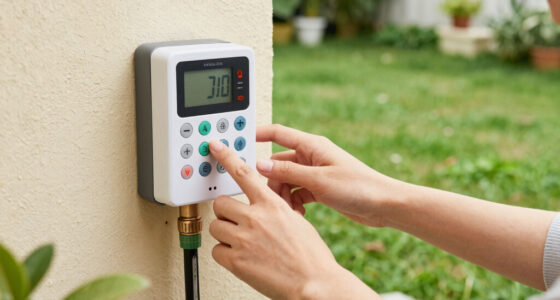
How to Program Your Timer for an Odd-Even Schedule in 3 Easy Steps
- Identify your property’s last address digit—odd or even.
- Set your timer to water only on the designated days. For example, program watering for Mondays, Wednesdays, and Saturdays if your address ends with an odd number.
- Adjust watering times to early morning or late evening—these are the best hours to minimize evaporation.
Many modern timers allow you to create multiple schedules or set custom days, making this process straightforward. Just remember: double-check your settings before saving.
Proper programming ensures your system adheres strictly to the schedule, which is vital for compliance. Incorrect settings can lead to overwatering or violations, risking fines or water waste. Consider also the implications of watering times; early morning reduces evaporation and fungal growth, while late evening minimizes water loss but may increase risk of disease if dew persists. The tradeoff involves balancing efficiency, plant health, and compliance. Taking the time to understand your timer’s features and carefully setting your schedule can prevent costly mistakes and ensure your lawn stays healthy while conserving water.
smart irrigation controller with weather sensors
As an affiliate, we earn on qualifying purchases.
As an affiliate, we earn on qualifying purchases.
Compare Fixed vs. Dynamic Restrictions—Which Works Better?
| Feature | Fixed Odd-Even Schedule | Weather-Responsive Schedule |
|---|---|---|
| Water-saving efficiency | Moderate, predictable | High, adjusts based on weather |
| Ease of setup | Simple, one-time setup | More complex, requires smart tech |
| Flexibility during rain | Limited, needs manual adjustments | Automatic, reduces unnecessary watering |
| Cost | Low, basic timers suffice | Higher, smart controllers needed |
While fixed odd-even schedules are easy to implement, weather-responsive systems can save even more water by adjusting based on real-time conditions. However, this flexibility comes with tradeoffs: increased complexity and higher initial costs. Fixed schedules are reliable and simple but may lead to overwatering during rainy periods, which wastes water and can harm plants. Conversely, weather-adaptive systems optimize water use but require investment in smart controllers and sensors, which might not be feasible for all budgets. The choice hinges on your priorities—whether you prefer simplicity and low cost or maximum efficiency and environmental benefit. Understanding these tradeoffs helps you decide which system best aligns with your water conservation goals and financial considerations.
As an affiliate, we earn on qualifying purchases.
Tips to Make Your Odd-Even Schedule Work Without a Hassle
- Use a smart timer that supports custom days and weather data.
- Set alarms or reminders to check your schedule monthly.
- Keep your system clean and well-maintained for reliable operation.
- Combine with rain sensors or soil moisture probes for maximum efficiency.
- Label your timers clearly, especially if you have multiple zones.
For example, if you forget to turn off your sprinklers during a rainstorm, your efforts are wasted. Sensors and alerts help you stay on top of your watering plan. Additionally, regularly inspecting and maintaining your system prevents malfunctions that could lead to overwatering or under-watering, both of which can harm your landscape and waste water. Using tools like rain sensors or soil moisture probes not only automates adjustments but also ensures your landscape receives water only when needed, which is one of the most effective ways to conserve water and keep plants healthy in restricted conditions.
soil moisture sensor for irrigation
As an affiliate, we earn on qualifying purchases.
As an affiliate, we earn on qualifying purchases.
What Could Go Wrong with Odd-Even Schedules—and How to Fix It
Sometimes, timers misfire or settings get lost. You might forget whether you set your system for odd or even days. Or, unexpected weather changes can disrupt your plan.
To fix this, double-check your programming weekly. Use a calendar app to mark watering days or set automatic alerts. If rain interrupts your schedule, consider installing a rain sensor that automatically pauses watering. Additionally, it’s important to understand that even the best programming can fail if not regularly monitored. Small mistakes like setting the wrong days or neglecting to update schedules after repairs can lead to overwatering or violations. Therefore, establishing a routine to review your system weekly ensures ongoing compliance and water efficiency. Incorporating automatic alerts or reminders helps you catch errors early, and installing sensors can prevent unnecessary watering during rain, further optimizing your water use and landscape health.
Frequently Asked Questions
How do I know if my city has watering restrictions?
Check your local water agency’s website or community notices. They usually publish schedules, rules, and updates during drought seasons or water shortages. It’s a good habit to stay informed and avoid penalties.
Can I exempt certain plants from odd-even restrictions?
Yes, some regions allow exemptions for newly planted lawns, vegetable gardens, or trees. Always verify local rules and document your exemption if needed, to stay compliant during restrictions.
What hours are best for watering under restrictions?
Early morning (around 4-6 a.m.) or late evening (after 8 p.m.) are ideal. These times minimize evaporation, especially in hot climates, and often align with local rules to reduce water waste.
What penalties can I face for breaking watering rules?
Penalties vary but can include fines, restrictions on water service, or other enforcement actions. Staying compliant not only saves water but also avoids unnecessary costs or legal trouble.
Are there smarter ways to water during restrictions?
Absolutely. Use drip irrigation, rain sensors, and smart controllers that adapt to weather. These tools help you water efficiently, saving water and time while keeping your landscape healthy.
Conclusion
Setting up an odd-even watering schedule isn’t just about following rules—it’s about smart, responsible water use. With a little planning and the right timer, you can keep your lawn lush while conserving precious resources.
Think of it like a rhythm for your yard—regular, fair, and efficient. When you program your system correctly, you turn water restrictions into an opportunity to be a smarter gardener.
NFL season / tailgating Picks
team gear
As an affiliate, we earn on qualifying purchases.