
TL;DR

Get home appliances delivered free with Prime
- Fast, free delivery on millions of items
- Prime Video, Amazon Music and more included
- Member-only deals all year
Using a timer for your turtle’s basking light ensures a consistent day-night cycle, which is crucial for their health. Choosing the right timer—whether mechanical, digital, or smart—helps you maintain a stable environment and reduces stress for your pet.
Imagine the rich, warm glow of a sunset, streaming into your turtle’s tank, signaling the end of a busy day. That’s what a proper basking light cycle mimics in your home. It’s not just about brightening the tank; it’s about creating a natural rhythm that keeps your turtle lively and healthy. But setting up that cycle? That’s where timers come in. They take the guesswork out, ensuring your turtle gets the same light exposure every day—no matter what.
In this guide, you’ll learn how to pick the right timer, set up the perfect schedule, and troubleshoot common issues. Achieving the right cycle doesn’t have to be complicated. With the right tools and a little know-how, you’ll create an environment where your turtle thrives—bright days, quiet nights, and all the health benefits in between.
Choose a timer rated for your basking light’s wattage and environment—waterproof for humid setups.
Set a consistent cycle of 10-12 hours of light to mimic natural conditions and support turtle health.
Gradually adjust the schedule seasonally, especially if your turtle’s environment changes with the seasons.
Test your timer regularly to catch any disruptions early and prevent health issues.
Smart timers offer customization and remote control but are not necessary for basic setups—simple timers work fine for most hobbyists.
Why a Proper Light Cycle Matters for Your Turtle’s Health
Think of your turtle’s day as a natural rhythm—light in the morning, darkness at night. This cycle is fundamental because it regulates their internal biological clock, which influences sleep, feeding, and overall activity levels. When the light cycle is consistent, it helps your turtle develop and maintain healthy physiological processes, including shell growth and vitamin D3 production that are vital for calcium absorption. Disrupting this rhythm can lead to stress, weakened immune response, and developmental issues.
For example, irregular or insufficient lighting can cause your turtle to become lethargic, hide excessively, or develop soft shells and metabolic disorders. A timer ensures that the cycle remains predictable, which is especially important if your schedule varies or if you’re away. This consistency allows your turtle’s body to adapt, promoting natural behaviors and preventing health problems that stem from hormonal imbalances caused by inconsistent lighting. The implications are clear: a well-maintained light cycle is not just about visibility but about supporting the complex biological needs of your turtle for a long, healthy life.
As an affiliate, we earn on qualifying purchases.
Choosing the Best Timer for Your Turtle Tank
Not all timers are created equal, and selecting the right one involves understanding how each type influences your turtle’s environment. A mechanical timer, while simple and reliable, offers only basic on/off functionality, which might suffice for straightforward schedules but lacks flexibility for seasonal adjustments or complex routines. Digital timers provide more precise control and programmable features, allowing you to set multiple on/off cycles, which can be useful if you want to simulate dawn and dusk or vary the light duration throughout the year. Smart timers, with Wi-Fi connectivity and app control, give you the ultimate flexibility, enabling adjustments from anywhere, and even integrating gradual light changes to mimic natural sunrise and sunset patterns.
Choosing the right timer involves considering your setup’s complexity, your control needs, and your budget. For instance, a beginner with a small tank might prioritize a simple mechanical timer to keep things straightforward and cost-effective. Conversely, owners aiming for more naturalistic lighting effects or seasonal adjustments might benefit from a digital or smart timer. Importantly, ensure any timer you select is rated for the wattage of your basking light—typically around 100-150 watts—to prevent overloads. Additionally, water-resistant features are crucial if your setup is humid or outdoor, as they protect the electronics from moisture damage. Proper installation and testing are vital to ensure the timer functions correctly and reliably, providing peace of mind that your turtle’s environment remains consistent and safe.
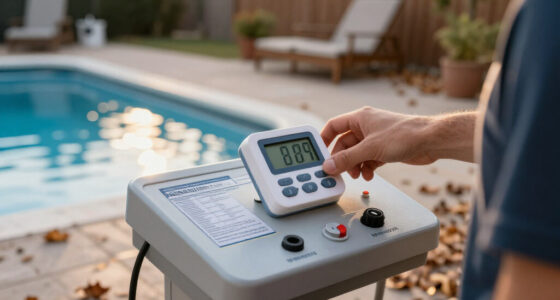
waterproof digital turtle light timer
As an affiliate, we earn on qualifying purchases.
As an affiliate, we earn on qualifying purchases.
How to Set Up Your Timer for the Perfect Light Cycle
- Determine the ideal hours of light for your turtle’s species—generally 10-12 hours—and consider any seasonal variations. Understanding these needs helps you tailor the cycle to mimic natural conditions, which are crucial for their biological rhythms. For instance, some species require longer days during breeding season, while others need shorter winter cycles. These adjustments support reproductive health, metabolic balance, and overall vitality.
- Choose a start time that aligns with your daily routine—early morning or late afternoon—keeping in mind that consistency is key. Fluctuating start times can confuse your turtle’s internal clock and lead to stress or irregular behavior. Setting a fixed schedule helps your pet adapt and thrive in a predictable environment.
- Program your timer to turn on at the selected start time and off after the desired duration—usually 10-12 hours. Consider the implications of longer or shorter cycles; longer exposure supports shell and bone health, while too much light can cause stress or overheating. It’s a delicate balance that requires observing your turtle’s behavior and adjusting accordingly.
- Test the setup by observing the light cycle for at least a couple of days, ensuring the timer switches on and off as intended. This step prevents accidental disruptions that could stress your turtle or cause health issues. Regular testing helps you fine-tune the schedule and confirms the reliability of your setup.
- Place the timer in a dry, secure location away from water splashes or humidity, especially if not waterproof. Proper placement reduces the risk of electrical issues and extends the lifespan of your device. Consider accessibility for future adjustments or troubleshooting.
- Monitor your turtle’s activity and health indicators—such as basking behavior, activity levels, and shell condition—and be prepared to adjust the cycle if signs of lethargy, overexposure, or stress appear. Fine-tuning the schedule based on observed behavior ensures the environment remains optimal for your turtle’s specific needs.
For example, if you want your turtle to bask from 8 a.m. to 6 p.m., program your timer accordingly, but also watch for signs that this schedule might need slight adjustments. Seasonal changes, like longer summer days or shorter winter ones, should be reflected gradually to prevent abrupt shifts that can unsettle your turtle. Remember, consistency in timing, not just duration, helps establish a stable internal clock—crucial for their health and well-being.
Using a backup power source, like a surge protector with a battery backup, can prevent disruptions during power outages. This ensures your turtle’s routine remains uninterrupted, reducing stress and maintaining their biological rhythm even during unforeseen events.
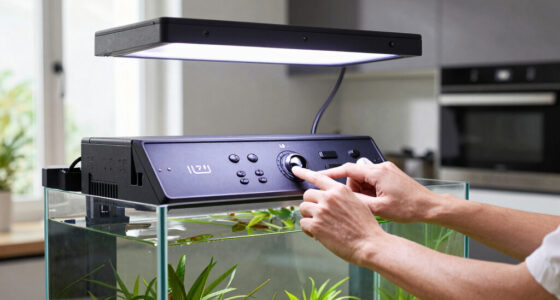
smart turtle tank light controller
As an affiliate, we earn on qualifying purchases.
As an affiliate, we earn on qualifying purchases.
Smart vs. Traditional Timers: Which One Fits Your Turtle Setup?
Smart timers incorporate Wi-Fi connectivity, allowing you to control and customize your basking light schedule remotely via smartphone apps. This feature is especially beneficial if you travel frequently or want to fine-tune lighting conditions without physically accessing the timer. Traditional timers, on the other hand, are basic devices with mechanical dials or push buttons, offering reliable on/off control but limited flexibility. The choice impacts how seamlessly you can adapt to your turtle’s changing needs and how much control you have over the environment.
Opting for a smart timer provides advanced features like gradual sunrise and sunset simulations, multiple on/off cycles, and seasonal adjustments—all of which can enhance your turtle’s natural light experience. However, these come at a higher cost and require a stable Wi-Fi connection. Traditional timers are more affordable and straightforward, making them suitable for simple routines where complex features aren’t necessary. Both options, when correctly set up and maintained, ensure your turtle receives a consistent light cycle—what matters most is matching the timer’s capabilities to your setup and your ability to manage it effectively.
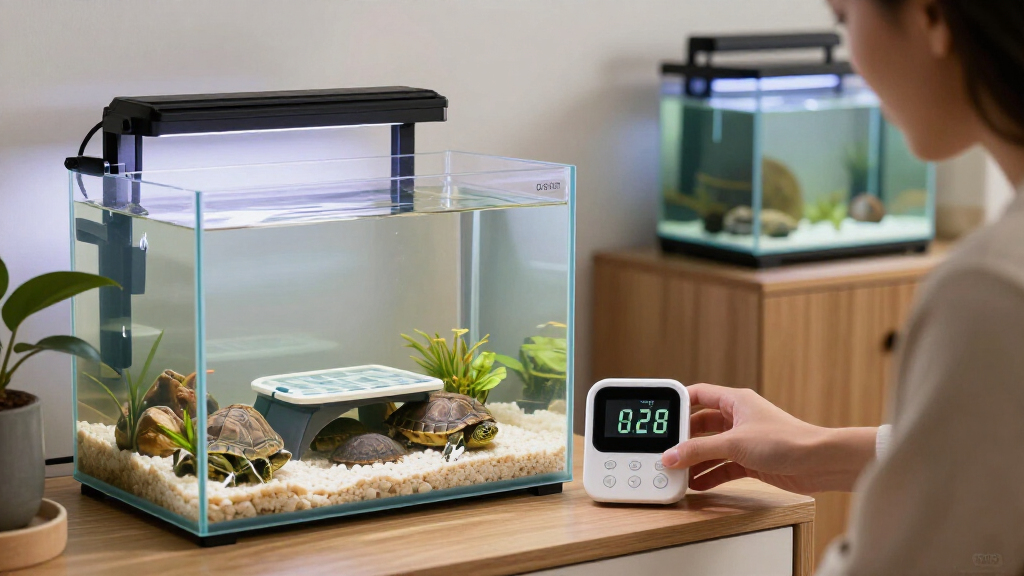
automatic turtle basking light switch
As an affiliate, we earn on qualifying purchases.
As an affiliate, we earn on qualifying purchases.
Troubleshooting Common Timer Issues
When your timer isn’t turning off or on as scheduled, it can cause stress to your turtle and disrupt their biological rhythm. The first step is to verify that the power source is stable and the timer’s settings are correctly programmed. Loose plugs, tripped circuit breakers, or overloaded outlets can interfere with operation. Overloading the timer with devices exceeding its wattage rating can cause it to fail or behave unpredictably, so always check that your basking light’s wattage falls within the device’s specifications.
If the schedule seems inaccurate, reset the timer and reprogram it, paying particular attention to time zone and daylight saving settings, especially with digital models. For smart timers, ensure your app is updated, the device is connected to Wi-Fi, and there are no network issues that could affect operation. Sometimes, firmware updates or app reinstallation can resolve glitches.
Regular testing is crucial: set your timer and observe its operation over a couple of days. Confirm that it switches on and off at the intended times, and note any discrepancies. Addressing these issues early prevents unexpected lighting disruptions that can stress your turtle or cause health problems. Maintaining a routine of checking and calibrating your timer ensures consistent lighting conditions, which are vital for your turtle’s well-being and stress management.
Conclusion
Getting the cycle right isn’t just about flipping a switch; it’s about crafting a natural rhythm that keeps your turtle vibrant and stress-free. A reliable timer is your best tool for consistent care, freeing you from daily manual adjustments. Invest the time in setting it up properly, and your turtle will thank you with lively basking and healthy shells.
Remember, a well-timed light cycle is a small change with a big impact—your turtle’s health depends on it. After all, a happy turtle is a thriving turtle, basking happily under the warm glow of a well-scheduled light.
Fall Picks
fall essentials
As an affiliate, we earn on qualifying purchases.