
TL;DR
Timing your pond aeration and waterfalls correctly ensures healthy fish and clean water. Using smart scheduling, especially during seasonal changes and hot months, makes a big difference in pond health.
If you’ve ever watched fish gulping at the surface on a hot summer day, you know oxygen levels can drop fast. That’s where thoughtful aeration and waterfalls come into play, not just for looks but for fish survival. Setting the right schedule ensures your pond stays lively and balanced, no matter the season.
In this guide, you’ll learn exactly when and how to run your pond’s aerators and waterfalls for maximum benefit. We’ll cover seasonal tips, smart tech, and real-world examples to keep your pond thriving.
Timing aeration in early morning and late evening helps maintain high oxygen levels during critical times.
Seasonal adjustments—more aeration in summer, careful in winter—are key to pond health.
Combine waterfalls with diffused aeration for larger ponds to ensure even oxygen distribution.
Smart sensors and timers optimize energy use and respond to real-time water conditions.
Proper planning prevents fish stress, algae blooms, and water stagnation, saving you headaches later.
Timing Pond Aeration & Waterfalls for Fish Health
Aeration is life support, not merely decoration. A season-aware schedule keeps oxygen moving when fish need it most—through hot nights, temperature swings, heavy biological demand and winter ice.
Dissolved oxygen floor for healthy fish survival.
A stronger comfort zone for active, resilient fish.
Potential oxygen improvement in moderate-sized ponds.
Prioritize early morning and late evening.
Match aeration to the calendar
Water temperature, plant activity and fish metabolism shift through the year. Adjusting the schedule prevents thermal layering, trapped gases and sudden oxygen crashes.
Restart gradually
As water warms, aeration restores circulation and helps prevent stratification. Increase runtime progressively to avoid forcing very cold bottom water upward too quickly.
Break thermal layersRun longer
Warm water holds less oxygen while fish, plants and microbes consume more. Extend operation through hot spells, with special focus on nighttime and dawn.
Maximum supportStabilize oxygen
Maintain circulation as leaves and organic matter begin decomposing. Consistent oxygen supports breakdown and prepares fish for lower winter metabolism.
Manage organicsKeep gas exchange open
Use gentle, shallow aeration to preserve an ice-free opening. Avoid disturbing the warmer bottom refuge where dormant fish gather.
Protect open waterProtect the hours when oxygen falls
Plants generate oxygen in daylight, but fish, plants and microbes continue respiring after sunset. The lowest dissolved oxygen reading commonly arrives near dawn.
Choose by volume and depth
An undersized unit leaves oxygen-poor zones; an oversized unit wastes energy. Pond volume, depth, fish load and local climate all shape the correct system.
| Pond size | Recommended system | Water-column reach | Best use | Watch-out |
|---|---|---|---|---|
| Up to 1,000 galSmall pond | Fountain or waterfallSimple surface agitation | ~ Surface-focused | Ornamental ponds with modest fish loads | May fall short in heat or with dense stocking |
| 1,000–10,000 galMedium pond | Surface + diffusedFlexible hybrid approach | ✓ Surface and deeper zones | Most backyard ecosystems | Balance airflow and diffuser placement |
| Over 10,000 galLarge pond | Diffused or hybridBottom-up circulation | ✓ Broad, uniform coverage | Deep water and high biological demand | Requires correct sizing and professional placement |
Surface beauty meets deep circulation
Each approach solves a different oxygen problem. Combining them creates redundancy and reduces the likelihood of stagnant pockets during peak demand.
Waterfall
Creates turbulence, supports gas exchange and adds an attractive visual focal point.
Diffuser
Moves bubbles upward, circulating deeper water and reducing thermal layering and dead zones.
Hybrid
Pairs visible surface agitation with deep circulation for stronger protection across the pond.
A waterfall oxygenates the surface while diffused aeration circulates the lower water column—the combination closes the gaps that either method can leave alone.
Let real-time conditions set the schedule
Sensors, timers and weather-aware controllers can respond before fish show visible stress. Automation also avoids unnecessary runtime when oxygen is already sufficient.
Waterfalls may raise oxygen in moderate-sized ponds while also improving circulation and visual appeal.
Beautiful movement with a practical limit
Falling water expands the air–water contact area and disrupts the surface film, improving oxygen transfer. It also discourages stagnation and helps distribute nutrients. But during heat, high fish loads or overnight oxygen depletion, surface movement alone may not reach deeper water.
Build a fish-first aeration schedule
Start with pond characteristics, focus on vulnerable hours, then let monitoring refine the plan. The goal is stable oxygen—not simply the longest possible runtime.
Assess
Measure volume, depth, fish load, shade and local weather patterns.
Match
Select surface, diffused or hybrid equipment for the pond’s real demand.
Schedule
Prioritize late evening through early morning, especially in summer.
Adapt
Increase support during heat, seasonal turnover and winter ice risk.
Monitor
Watch fish behavior and use sensor data to tune runtime and output.
The healthy-pond formula
Consistent oxygen, complete circulation and adaptive timing work together to protect fish and maintain clearer, more balanced water.
When to Start Aerating: The Season-by-Season Breakdown
Timing your aeration begins with understanding your pond’s seasonal needs. In spring and fall, aeration helps break down thermal layers and supports fish during temperature swings. During summer, oxygen can dip sharply, so extra effort is needed. In winter, aeration prevents ice from forming and keeps a hole open for fish to breathe.
For example, in early spring, turning on aerators as water warms helps prevent stratification, which can trap toxic gases. In late fall, aeration keeps oxygen levels steady as fish prepare for winter dormancy. In colder climates, continuous aeration during winter prevents dangerous ice cover.
Understanding these seasonal patterns is crucial because oxygen levels are directly affected by temperature and biological activity. If you ignore these patterns, you risk fish stress, algae blooms, and water quality issues. Proper timing ensures your pond maintains a healthy balance and reduces the need for emergency interventions.

VEVOR Pond Aerator, 550W Power, 5.2CFM for Up to 3 Acre 50' Lake, Pond Aeration Kit Includes 3/4 HP Compressor & Timer & Valves, Air Compressor for Deep Water Oxygen Circulation, for Pond, Lake
- Enhances Water Quality: Reduces muck and improves oxygen levels
- Powerful and Quiet: 550W, 3/4 HP, 5.2 CFM, 65dB noise level
- Suitable for Large Ponds: Affects ponds up to 3 acres, 50 ft deep
As an affiliate, we earn on qualifying purchases.
As an affiliate, we earn on qualifying purchases.
Best Times of Day to Aerate for Fish and Water Quality
Oxygen levels fluctuate throughout the day due to photosynthesis by aquatic plants and respiration by fish. During daylight hours, especially midday, plants produce oxygen, but at night, respiration dominates, causing oxygen levels to fall. Early morning and late evening are critical periods when oxygen can become dangerously low.
Running aeration systems during these periods ensures a continuous supply of oxygen, preventing fish stress or suffocation. This is especially important during hot days when oxygen solubility decreases and biological activity increases, amplifying oxygen demand. Proper timing during these windows helps maintain a stable environment, reducing fish mortality and algae overgrowth caused by stress and stagnation.
The tradeoff is that running aerators during the day when oxygen levels are naturally higher might be less necessary, but during dawn and dusk, it can be a lifesaver. Investing in timers or sensors that automate this process means you can optimize oxygen levels without wasting energy, leading to healthier fish and clearer water.
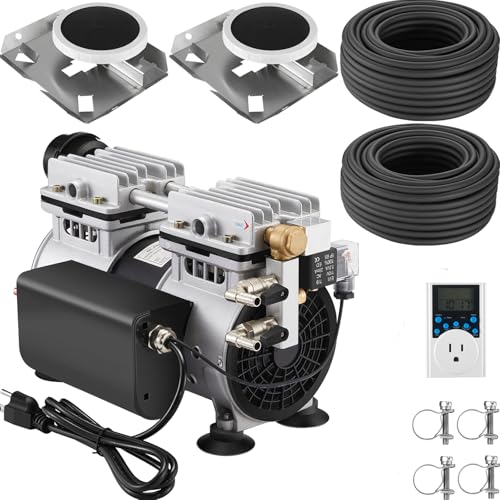
WRSTER-TECH Pond Aerator, 5.2 CFM for Pond and Lakes Up to 3 Acres, 3/4 HP Compressor + 200' Weighted Tubing + 2 Diffusers + Timer, Aeration Pumps Kit for Deep Water Oxygen Circulation
- Durable Copper Motor: Long-lasting, cost-effective operation
- All-Season Use: Operates from 0℉ to 100℉, winter deicer
- Powerful 3/4 HP Compressor: Efficient, quiet, 5.2 CFM airflow
As an affiliate, we earn on qualifying purchases.
As an affiliate, we earn on qualifying purchases.
Choosing the Right Aeration System for Your Pond Size
| Pond Size | Recommended System | Notes |
|---|---|---|
| Small ponds (up to 1,000 gallons) | Surface fountains or small waterfalls | Easy to install, aesthetically pleasing, and suitable for light aeration needs. They are ideal for ornamental ponds, but may not provide sufficient oxygen in hotter months or during high fish loads. |
| Medium ponds (1,000-10,000 gallons) | Combination of surface and diffused aeration | This hybrid approach offers better oxygen circulation throughout the water column, reducing stratification and supporting a balanced ecosystem. It’s a flexible option for most backyard ponds. |
| Large ponds (over 10,000 gallons) | Diffused aerators or hybrid systems | Ensures uniform oxygen distribution and prevents dead zones. These systems are more energy-efficient at large scales but require proper sizing and installation to maximize benefits. |
Choosing the right system involves considering your pond’s size, fish load, and budget. Oversized systems waste energy, while undersized ones fail to meet oxygen demands. Properly matched equipment helps maintain consistent oxygen levels, reduces fish stress, and prevents algae blooms caused by stagnation.

Smart Dissolved Oxygen Meter | Portable DO Meter for Pond, YINMIK Aquaponic Dissolved Oxygen Test Kit, Digital Dissolved Oxygen Tester for Aquarium, Fish Tank, Hydroponic, Beer Wort, Lake, Aquaculture
- High-Precision Measurement: Measures dissolved oxygen with 0.01 mg/L resolution
- Dual Measurement Modes: Displays in mg/L and % modes
- Wide Measurement Range: 0-30 mg/L and 0-300%
As an affiliate, we earn on qualifying purchases.
As an affiliate, we earn on qualifying purchases.
Smart & Eco-Friendly Aeration: The Future of Pond Care
New tech makes aeration smarter and greener. Sensors monitor oxygen levels 24/7, adjusting the system automatically to match real-time needs. Solar-powered aerators cut energy costs and reduce environmental impact, making pond management more sustainable. Some systems can even sync with weather forecasts, preemptively turning on before hot days or cold snaps to stabilize oxygen levels.
For example, automated systems in backyard ponds can detect drops in oxygen during heatwaves and respond instantly, preventing fish stress and mortality. This proactive approach not only protects aquatic life but also minimizes energy waste, as the system operates only when necessary. The tradeoff is initial investment, but the long-term savings and ecological benefits often outweigh the costs, making these options attractive for environmentally conscious pond owners.

Aquascape 75000 Pond Air 2 (Double Outlet Aeration Kit)
- Product Type: Double Outlet Pond Aeration Kit
- Suitable Pond Size: Up to 2,000 gallons
- Energy Efficiency: Quiet, energy-efficient operation
As an affiliate, we earn on qualifying purchases.
As an affiliate, we earn on qualifying purchases.
How Waterfalls Boost Oxygen and Beautify Your Pond
Waterfalls aren’t just pretty—they play a vital role in aeration by increasing surface agitation, which enhances oxygen transfer from the air into the water. This process is crucial because the surface is where oxygen exchange occurs, and turbulence helps maximize this transfer. Additionally, waterfalls promote water circulation, preventing stagnation and reducing nutrient buildup that fuels algae blooms.
Research indicates that in moderate-sized ponds, waterfalls can increase oxygen levels by 10-20%, but their effectiveness diminishes during peak demand or hot weather, when oxygen consumption spikes. During these times, waterfalls should be complemented with diffused aeration to ensure sufficient oxygenation throughout the entire water column. While waterfalls add aesthetic value and help with oxygen exchange, relying solely on them can lead to gaps in oxygen distribution, especially in larger or deeper ponds. Combining waterfall aeration with other methods provides a more reliable and comprehensive oxygenation strategy.
How to Schedule Aeration for Maximum Fish Comfort and Water Health
- Assess your pond’s size, fish load, and weather patterns. Understanding these factors helps tailor your aeration schedule to prevent stress and maintain water quality.
- Set your aeration system to run early in the morning and late at night during summer, aligning with natural oxygen fluctuations. This timing supports fish during the most vulnerable periods and reduces the risk of hypoxia.
- Use smart timers or sensors to adjust based on real-time oxygen data. This automation ensures you’re not wasting energy or running systems unnecessarily, which is both cost-effective and environmentally friendly.
- During seasonal transitions, increase aeration frequency to prevent stratification in spring and fall, and to keep ice from forming in winter. Proper adjustment reduces fish mortality risks and maintains consistent water quality.
- Combine waterfalls with diffused aeration in larger ponds for even oxygen distribution, especially during hot weather or high fish densities. This layered approach ensures no part of the pond becomes oxygen-starved.
For example, in a 5,000-gallon pond, setting a timer to run the waterfall from 6-9 a.m. and 6-9 p.m., with additional diffused aeration during peak heat, keeps oxygen levels stable and fish stress-free. Effective scheduling requires understanding your pond’s unique conditions and being flexible with adjustments to optimize health and clarity.
Frequently Asked Questions
When is the best time to start aerating my pond?
Start aerating in early spring as water warms, and continue into fall. During hot summer days, run aerators more frequently, and in winter, use aeration to prevent ice from forming and support fish survival.
How do I tell if my fish are stressed from low oxygen?
Watch for fish gulping at the surface, sluggish behavior, or excessive hiding. In severe cases, fish may die suddenly, signaling critically low oxygen levels.
What system works best for small versus large ponds?
Small ponds benefit from simple surface fountains or small waterfalls, while larger ponds need diffused aeration or hybrid systems to circulate oxygen evenly across the water.
Can waterfalls alone keep oxygen levels high enough?
Waterfalls help aerate surface water but often aren’t enough during peak oxygen demand. Combining them with diffused aeration offers a more reliable solution, especially in hot weather or larger ponds.
Are eco-friendly aeration options available?
Yes. Solar-powered and energy-efficient aerators are increasingly accessible and provide effective oxygenation with less environmental impact and lower operating costs.
Conclusion
Getting your pond’s aeration timing right is a simple step with big rewards. It keeps your fish lively, water clear, and your pond looking beautiful all year. Think of it as giving your pond a healthy heartbeat—steady, predictable, and tuned to the seasons.
Remember: regular adjustments based on weather and season make all the difference. With the right setup, your pond becomes a lively, thriving oasis you won’t have to babysit constantly.